
What Is Creosote Buildup in Washington Chimneys — And Why It Gets Expensive Fast
Creosote is the residue left when wood smoke cools and condenses inside your chimney flue instead of exiting to the outside air. It starts as a light, dusty layer and hardens through three distinct stages, each progressively more difficult — and more costly — to remove. In Washington’s cooler, humid climate, where shoulder-season fires and green Pacific Northwest firewood are common, that progression from Stage 1 to Stage 2 happens faster than most homeowners realize.
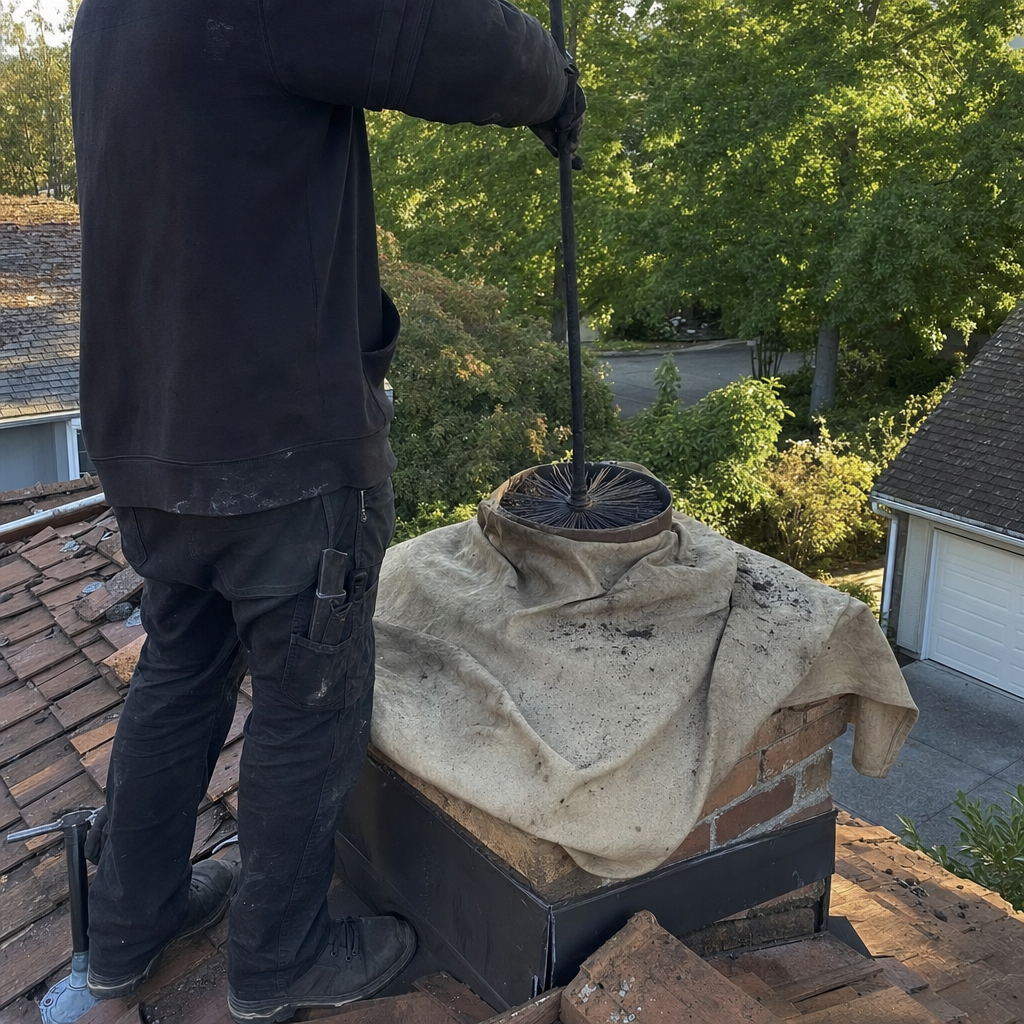
We’ve pulled all three stages out of flues across Washington, from the older masonry chimneys in Georgetown to the prefab fireplace systems in newer Foggy Bottom condos. James Wilson, our owner and lead technician, has seen what each stage costs when it’s ignored — and it’s never cheaper to wait.
How Creosote Actually Forms in Washington Homes
Wood doesn’t burn completely. Even well-seasoned hardwood releases smoke containing tar vapors, water vapor, and unburned carbon particles. When that smoke hits the cooler upper walls of your flue, it condenses. The result is creosote — but “residue” undersells what it becomes.
Washington’s climate accelerates this process in ways national averages don’t capture. Our ambient temperatures stay lower for longer, especially in fall and spring when homeowners light “shoulder season” fires to take the chill off. Those smaller, slower burns produce more smoke relative to heat, and the flue never reaches the sustained high temperatures that would carry that smoke cleanly out. Instead, it lingers, cools, and deposits.
Then there’s the wood itself. Fir and alder — common in local cordwood deliveries — are often sold green or semi-seasoned. Burning wood with moisture content above 20% forces the fire to boil off water before it can generate useful heat, producing thick, cool smoke that coats the flue aggressively. We’ve opened chimneys in Capitol Hill rowhouses where the homeowner was burning “seasoned” wood that was still reading 35% moisture on our meter.
The condensation point matters mechanically, not just chemically. A flue needs to stay above approximately 250°F for smoke to maintain enough buoyancy to escape without depositing. Washington’s combination of cool outside air, damp fuel, and low-intensity fires keeps too many flues below that threshold for too long.
The Three Stages of Creosote Buildup — What Each One Actually Looks Like
Every generic explanation tells you creosote is “flammable.” What they don’t explain is that each stage requires a fundamentally different removal method, and only Stage 1 comes off with standard sweeping. Here’s what 17 years of Washington flue inspections has taught us about the progression.
Stage 1: Dry, Dusty, and Still Honest
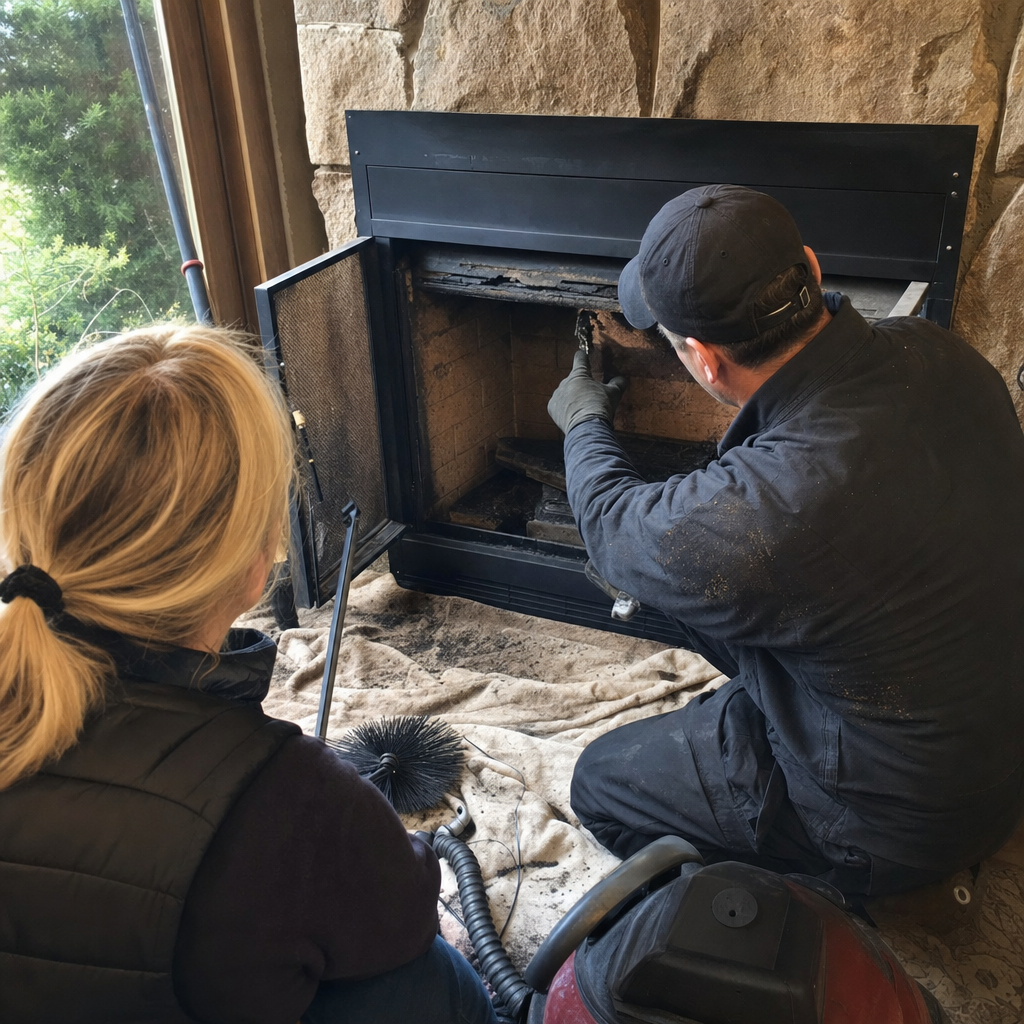
Stage 1 creosote looks like fine black soot or light powder. It brushes off with a standard chimney sweep brush during a routine Chimney Cleaning & Sweep. It has virtually no odor, no sheen, and no structural integrity. If we could catch every flue at this stage, chimney fires would be a historical curiosity.
The catch: Stage 1 doesn’t stay Stage 1. In Washington’s conditions, we’ve seen it advance to Stage 2 within a single burning season — especially in exterior chimneys on north-facing walls that never warm up, or in homes where the fireplace is used for ambiance fires a few times weekly rather than sustained heating.
Stage 2: Flaky, Shiny, and Stubborn
Stage 2 creosote has begun to polymerize. It forms hard, brittle flakes with a distinct tar-like sheen — imagine shattered obsidian or hardened tree sap. These flakes cling to the flue wall with enough tenacity that a standard brush just skims the surface. The flakes break off and fall, but the base layer remains.
Removing Stage 2 requires rotary cleaning tools — spinning chains or whips driven by a power drill — and often chemical treatment to soften the deposit first. This isn’t a standard sweep anymore. It’s a remediation job, and it takes longer, costs more, and demands a technician who knows when to stop grinding before damaging the liner beneath.
We find Stage 2 regularly in Washington homes that skipped a season or two of cleaning, or where the homeowner switched to “convenience” fire logs that burn cooler than split hardwood. In the Tenleytown neighborhood where James grew up, we’ve pulled thick Stage 2 deposits from 1920s brick chimneys where the original clay liner has seen decades of slow accumulation.
Stage 3: Glazed, Fused, and Dangerous
Stage 3 creosote is the one that keeps us up at night. It forms when Stage 2 deposits are repeatedly heated and cooled, melting and re-hardening until they form a glossy, enamel-like coating fused directly to the liner wall. It looks like burnt caramel or volcanic glass. It cannot be brushed off. It cannot be rotary-whipped off without destroying what’s underneath. It is, for practical purposes, part of the chimney now.
Here’s the fire science that matters: glazed creosote ignites at approximately 451°F — lower than the ignition temperature of the wood you’re burning. Once lit, it burns at temperatures exceeding 2,000°F. Clay tile liners crack at roughly 1,800°F. Stainless steel liners warp and fail at sustained temperatures above 2,100°F. That gap is narrow, and Stage 3 creosote burns hot enough to close it.
The chimney fire mechanism is specific and brutal. The creosote ignites, burns with intense, concentrated heat against the liner wall, and either cracks the liner directly or heats adjacent framing to ignition through thermal conduction. We’ve inspected chimneys in Washington where the homeowner didn’t even know they’d had a fire — the creosote burned itself out, but the liner was cracked and the surrounding framing charred. They found out when they called us because “the fireplace smells weird.”
What Each Stage Costs — The Financial Case for Early Cleaning
We don’t quote exact Chimney Cleaning Cost in Washington, WA without seeing the flue, but we can map stages to cost categories based on 17 years of Washington invoices. The pattern is consistent: earlier is dramatically cheaper.
| Stage | Typical Scope | Cost Category |
|---|---|---|
| Stage 1 | Standard sweep with brush and vacuum | Base cleaning rate |
| Stage 2 | Rotary mechanical cleaning + chemical treatment + full liner inspection | 1.5–2.5× base rate |
| Stage 3 | Chemical treatment cycle (often repeated) or liner replacement/resurfacing | 3–8× base rate, or full liner rebuild |
The jump from Stage 2 to Stage 3 is where costs spiral because removal becomes destructive. If the glazed layer has compromised liner integrity, we need to evaluate whether the liner can be resurfaced with HeatShield cerfractory sealant or whether a full DuraFlex stainless steel liner replacement is warranted. Both are valid solutions we’ve installed across Washington, but neither is cheap — and neither should have been necessary if the flue had been swept at Stage 1.
James puts it directly: “I’ve never met a homeowner who was glad they waited. I’ve met plenty who wish they’d called two seasons earlier.”
Washington-Specific Scenarios We See Repeatedly
Certain patterns show up often enough in our Washington work that we can predict them. These aren’t hypotheticals — they’re the calls we get every fall when homeowners light the first fire.
- The Capitol Hill rowhouse with an exterior chimney. Three stories of brick on the north side, never sees sun, flue temperature stays low all winter. These accumulate Stage 2 faster than any other configuration we service. We schedule these for mid-season checks, not just annual sweeps.
- The “we only use it for ambiance” homeowner in Dupont Circle. Four small fires per winter, each one a low-temperature burn with the damper barely open. Total fuel consumption is low, but creosote deposition per fire is high. They assume infrequent use means less maintenance; the opposite is true.
- The recently purchased home with no sweep records. Common in Brookland and Petworth where 1920s–1950s stock turns over frequently. We find Stage 2 or 3 in roughly 40% of first-time inspections on these properties. The previous owner either didn’t know or didn’t disclose.
- The gas-log conversion with an uncleaned wood flue. Homeowners switch to gas for convenience, never sweep the wood residue, and moisture from gas combustion mixes with old creosote to accelerate deterioration. We inspect these with a camera before any gas appliance installation.
How We Assess and Address Creosote at Horizon Chimney Sweep
Our inspection protocol starts with a visual and camera evaluation — we need to know the stage before we quote the work. For Stage 1, we sweep same-day with standard brushes and HEPA vacuum. For Stage 2, we schedule the rotary cleaning with appropriate chemical pre-treatment, using Olympia Chimney and Famco products matched to the deposit type and liner material.
Stage 3 requires honesty about options. Sometimes a chemical treatment cycle — applying a modifier, heating it to work into the glaze, then mechanical removal — can restore a usable surface. Sometimes the liner is too compromised, and we recommend HeatShield resurfacing for clay tile liners or a DuraFlex stainless liner insert. James makes that call himself on every job; there’s no sales team pushing the more expensive option.
Our home page outlines the full scope, but the principle is simple: we don’t leave until we’ve explained exactly what we found, what stage it was, and what would have happened if you’d waited another season.
FAQs
A standard Stage 1 sweep runs at our Affordable Chimney Cleaning & Sweep in Washington, WA base rate, while Stage 2 typically costs 1.5–2.5× that due to rotary tools and chemical treatment, and Stage 3 can reach 3–8× or require liner replacement. The exact price depends on flue accessibility, liner type, and deposit thickness — call (866) 541-8697 for a free, no-pressure assessment and written estimate.
Stage 1 soot can be reduced with proper burning practices, but actual flue cleaning requires professional equipment and a camera inspection to confirm complete removal. Stage 2 and 3 deposits absolutely require professional treatment — DIY attempts with hardware-store brushes on glazed creosote risk damaging the liner, missing hidden deposits, or creating a fire hazard through incomplete removal. We’ve been called to fix DIY attempts that made the situation worse.
The National Fire Protection Association recommends annual inspection for all wood-burning systems, and in Washington’s climate we agree — though heavy-use homes and exterior chimneys often benefit from mid-season checks. Our 17 years of local data shows that “once per burning season” catches Stage 1 before it advances, while biennial schedules often find Stage 2 already established.
Properly seasoned hardwoods like oak and maple produce less creosote than softwoods or green wood, but no wood burns completely cleanly. The key factors are moisture content (below 20%), adequate air supply, and sustained flue temperature above 250°F. Even ideal wood and technique still produce some creosote — annual inspection and cleaning remain necessary. We’ve found significant buildup in chimneys burning only kiln-dried hardwood; the “right” wood delays accumulation but doesn’t eliminate it.
When to Call — And What to Expect
If you smell smoke where you shouldn’t, notice black flakes in your firebox, or can’t remember your last professional sweep, your flue is telling you something. We’ve built Horizon Chimney Sweep on the principle that homeowners deserve to understand what’s in their chimney before they pay to address it.
James Wilson still carries the tools himself, still makes the diagnostic calls, and still explains findings in plain language — because after 17 years and over 1,006 verified reviews, we’ve learned that trust is built on transparency, not urgency. A clean chimney isn’t a luxury — it’s just the part of your house that’s been quietly doing its job and deserves the same attention as everything else.
If you’d rather have it looked at, Horizon Chimney Sweep Washington offers the Best Chimney Cleaning & Sweep in Washington, WA with a no-pressure assessment in Washington — call (866) 541-8697.
Written by James Wilson, Owner & Lead Technician at Horizon Chimney Sweep Washington, serving Washington, WA.