
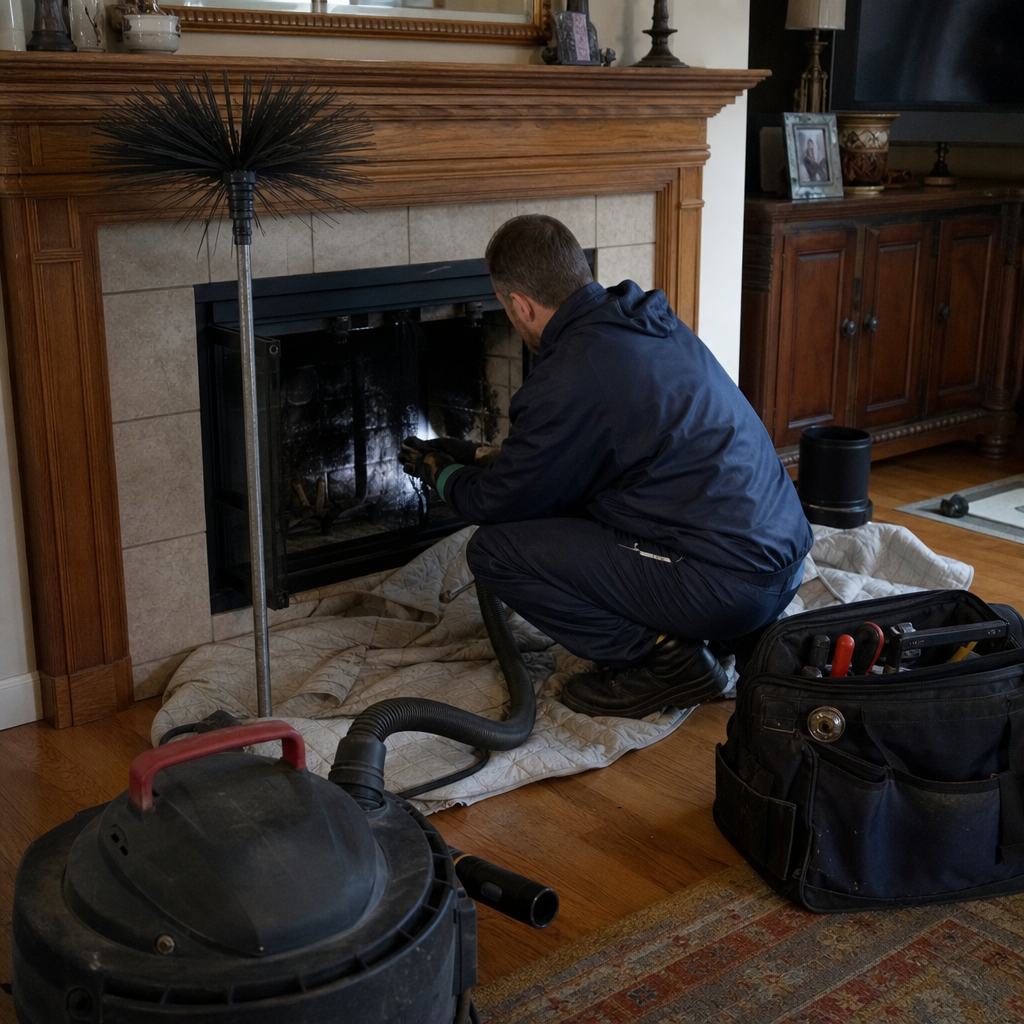
Chimney Cleaning Cost in Washington, WA: What You’ll Actually Pay Based on What’s Inside Your Flue
A standard chimney sweep in Washington, WA typically runs $180–$280 for a routine cleaning with inspection. If we find Stage 2 or Stage 3 creosote buildup, costs climb to $350–$850 or higher because the job shifts from sweeping to mechanical removal or liner restoration. Call (866) 541-8697 for a free estimate — we’ll tell you which stage you’re in before any work starts.
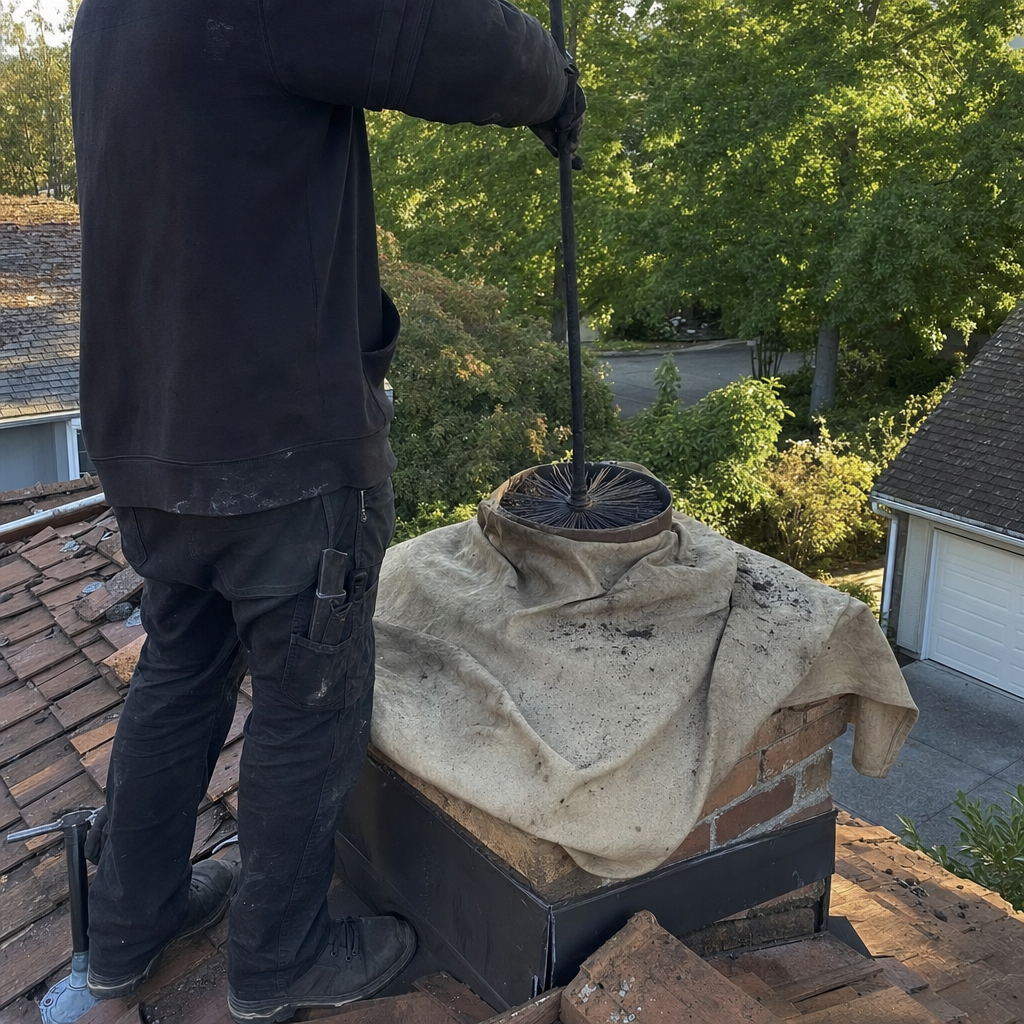
Last October, James Wilson climbed onto a roof in the Shepherd Park neighborhood and pulled a baseball-sized chunk of glazed creosote from a flue that the homeowner had cleaned just two years prior. The resident was stunned — no smoke backup, no odd smell from the hearth, nothing that signaled trouble. But Washington’s pattern of cool, damp shoulder-season fires had done exactly what it does: burned at low temperatures for short periods, letting creosote harden layer by layer without ever reaching the sustained heat that would have burned it clean. That chimney went from a $220 cleaning to a $640 liner resurfacing job with HeatShield. The homeowner’s first question was reasonable: “How was I supposed to know?”
You weren’t. That’s the honest answer. What you can know before you call is how chimney cleaning cost works in Washington, WA and what drives it upward — so when we scope your flue with a camera, the number we quote makes sense rather than feeling arbitrary.
How Creosote Stages Map to Real Prices in Washington
Most chimney services in Washington, WA quote a flat “sweep and inspect” rate and leave it at that. We don’t, because “sweep and inspect” covers only Stage 1 conditions — and after 17 years in this trade, James Wilson will tell you straight: about a third of the chimneys we clean in a season turn out to be in Stage 2, and the homeowner had no idea because it doesn’t smell or look different from the living room.
Here’s how the stages break down, what each requires, and what we charge:
| Service | Condition | Price Range |
|---|---|---|
| Standard sweep + Level 1 inspection | Stage 1 creosote (sooty, brush-removable) | $180 – $280 |
| Deep mechanical cleaning + inspection | Stage 2 creosote (glazed, hard, requires rotary chains or chemical treatment) | $350 – $550 |
| Stage 3 removal + liner repair/resurfacing | Stage 3 creosote (tar-like, often fused to liner; may require partial rebuild) | $650 – $1,200+ |
| Full liner replacement with DuraFlex | Liner cracked or deteriorated beneath creosote | $2,500 – $4,500 |
Stage 1 is what most homeowners imagine: loose, powdery soot that a poly brush lifts out in twenty minutes. Stage 2 is where Washington’s climate becomes expensive. Those March evenings when you light a fire for three hours because the temperature dipped to 45 degrees? The flue never fully heats. Creosote condenses and bakes into a hard, glossy shell that laughs at standard brushes. We switch to rotary chain whips or apply ACS anti-creosote treatment and return — and that second trip, that specialized equipment, that chemical cost, it all moves the needle.
Stage 3 is rarer but not rare enough. We’ve found it in chimneys where homeowners burned unseasoned wood from backyard trees in Chevy Chase DC, or where a previous owner never cleaned the flue at all. At that point, creosote has become a combustible lining of its own, and removal risks damaging the clay liner beneath. Sometimes we can resurface with HeatShield. Sometimes we need to drop a new DuraFlex stainless liner. Either way, you’re no longer paying for a cleaning; you’re paying to make the chimney safe to use again.
Why Washington’s Burn Patterns Hide Stage 2 Creosote
Washington, WA sits in a climate zone that works against chimneys in a specific way. We’re not Minnesota, where furnaces run hard for five months and fireplaces see consistent high-temperature use. We’re not Florida, where chimneys barely get touched. We’re the in-between — and that in-between is where glazed creosote thrives.
Consider how a typical Washington homeowner actually uses their fireplace:
- April evening, 52 degrees: fire lit at 7 PM, burned until 10 PM, flue temperature peaked around 250°F
- October morning, 48 degrees: quick fire to “take the chill off,” extinguished by noon
- December holiday: sustained burn for appearance, damper half-closed to keep heat in the room
Every one of those patterns produces creosote. None of them produce the 500°F+ sustained temperatures that would burn it off. The result is a flue that looks fine from below, scopes clean at first camera angle, and reveals glazed ridges three feet up where the smoke cooled fastest. James Wilson has learned to expect this in certain Washington housing stock — the pre-war brick colonials in American University Park, the 1960s split-levels in Spring Valley with original clay liners that never had proper caps installed.
Caps matter here too. Washington’s tree canopy is dense — oaks in Northwest DC, maples in Forest Hills — and leaves plus moisture down an open flue accelerate liner deterioration. A damaged liner creates cooler surface temperatures, which accelerates creosote condensation, which accelerates liner damage. The cycle feeds itself until someone with a camera interrupts it.
Cleaning-Only vs. Cleaning-Plus-Inspection: The $50 Mistake
We get calls asking if we’ll skip the inspection to save money. The short answer is no. The longer answer is that we’ve rebuilt enough chimneys for people who made that choice elsewhere to feel strongly about explaining why.
A cleaning without inspection runs $130–$180 at some Washington-area competitors. It removes visible soot from the firebox and lower flue. It does not scope the liner above the smoke shelf, check for crown cracks that let water freeze and expand, or identify the hairline fractures in flue tiles that separate during rapid temperature changes. Those fractures are how carbon monoxide seeps into wall cavities. They’re also how Stage 2 creosote becomes a liner replacement — because once tiles crack, creosote wedges in, heats, expands, and widens the gap season after season.
Our standard Chimney Cleaning & Sweep includes Level 1 inspection by default. James Wilson or one of our chimney-certified technicians runs a camera the full flue length, documents condition with photos you can see, and explains what stage you’re in before any additional work is proposed. The inspection adds roughly $60–$80 to the base sweep cost. Skipping it to save that money is how a $220 annual service becomes a $2,800 liner job three years later when the chimney fails a home inspection.
We’ve used HeatShield cerfractory resurfacing on dozens of Washington chimneys where inspection caught liner degradation early — a $1,200–$1,800 repair that restores a sound flue surface without full replacement. We’ve used DuraFlex stainless liners where damage was too extensive. Both products carry 20-year and lifetime warranties respectively, and both require a technician who understands how to spec the right gauge and diameter for your appliance. That’s not a handyman skill. That’s 17 years of chimney-only work.
What Else Moves the Price: Access, Height, and Appliance Type
Beyond creosote stage, a few Washington-specific factors affect your final quote:
Roof pitch and height. Three-story Victorians in Dupont Circle with 12/12 pitches require additional safety rigging. We don’t surcharge for standard two-story access, but steep or slate roofs where we can’t use standard roof ladders add $75–$150 for proper fall protection setup.
Insert vs. open hearth. A fireplace insert with a connected stainless liner requires disconnecting the appliance, cleaning the liner separately, and resealing the connection. That’s additional labor — typically $120–$200 above base sweep cost.
Gas log sets. Gas fireplaces burn cleaner but still produce acidic condensation that degrades mortar and collects debris. Cleaning runs $150–$220, but we always inspect the gas line connection and damper operation, which some competitors skip.
Blocked or animal-occupied flues. Raccoons in Tenleytown, squirrels in Friendship Heights — it’s seasonal, and removal plus cap installation with proper screening runs $280–$450 depending on access and whether masonry repair is needed after animal damage. We use Copperfield and Famco caps with stainless mesh that actually keeps wildlife out, not the lightweight aluminum versions that bend in two seasons.
Key Takeaways: What Washington Homeowners Should Know
- Base chimney cleaning with inspection in Washington, WA: $180–$280
- Stage 2 glazed creosote — common here due to shoulder-season burn patterns — pushes cost to $350–$550
- Stage 3 or liner damage requires repair/replacement: $650–$4,500 depending on severity
- Inspection is not optional if you want to catch Stage 2 before it becomes a liner job
- Washington’s damp climate and variable burn habits make annual inspection more critical than in colder or drier regions
FAQs
A standard chimney cleaning with Level 1 inspection costs $180–$280 in Washington, WA. If glazed creosote buildup requires mechanical removal, expect $350–$550. Call (866) 541-8697 for a free estimate — we’ll scope your flue and tell you exactly which category you fall into.
Resurfacing a damaged liner with HeatShield typically costs $1,200–$1,800, while a full DuraFlex stainless liner replacement runs $2,500–$4,500. Resurfacing is cheaper when damage is limited to surface cracking; replacement is necessary when tiles are missing or flue dimensions are compromised. We determine this during inspection, not guesswork. Call (866) 541-8697 to schedule.
We often have next-day availability for chimney cleaning near you in Washington, WA, though peak season (September through December) books 3–5 days out. Emergency calls for suspected blockages or smoke backup get priority scheduling. Call (866) 541-8697 and we’ll fit you in as soon as possible — estimates are always free.
Even minimal use produces creosote, and Washington’s damp climate lets moisture accelerate liner deterioration whether you burn frequently or not. Animal nesting, leaf debris, and freeze-thaw damage to mortar happen regardless of burn frequency. An unused chimney with a deteriorated liner is actually more dangerous than a regularly cleaned, actively used one because problems go undetected longer. Call (866) 541-8697 for an inspection that tells you where you stand.
Ready to Know What Your Chimney Actually Needs?
A clean chimney isn’t a luxury — it’s just the part of your house that’s been quietly doing its job and deserves the same attention as everything else. After 17 years and over 1,006 verified reviews, we’ve learned that homeowners in Washington, WA want two things: straight answers about what they’re paying for, and the confidence that the person on their roof has seen their exact situation before. James Wilson still leads jobs personally, still scopes every flue with the same attention he learned during his apprenticeship, and still explains the findings without padding the bill. Call (866) 541-8697 today for a free estimate — no stage surprises, no pressure, just the actual condition of your chimney and what it costs to make it right.
Written by James Wilson, Owner & Lead Technician at Horizon Chimney Sweep Washington, serving Washington, WA.