
Last updated July 11, 2026
Seasonal Chimney Cleaning Care for Seattle: Year-Round Homeowner’s Guide
Every chimney company in America tells you to schedule your sweep in September. In Seattle, that advice ignores six months of summer moisture damage that happens while your flue sits open and unattended. After 17 years of climbing Seattle roofs from Ballard to Beacon Hill, we’ve learned that Puget Sound chimneys follow a completely different calendar than the rest of the country. This guide breaks down what to do each season based on how Seattle’s marine climate actually attacks your masonry — not how some national blog thinks winter works.
Quick Answer
Seattle homeowners should treat summer as active chimney maintenance season to prevent moisture damage, schedule cleaning in early fall before the October rush, perform a spring damage assessment after the burn season ends, and monitor for creosote buildup during mild shoulder seasons when incomplete burns are common. Annual sweeping is the minimum; twice-yearly service makes sense for households burning more than three cords of wood per season or using their fireplace as primary heat.
Table of Contents
- Why Seattle Summer Is Actually Your Chimney’s Highest-Risk Season
- Fall Prep for a Mild Pacific Northwest Burn Season
- Managing Your Chimney During Seattle’s Shoulder Seasons
- Spring Post-Mortem: Reading the Signs After Your Last Fire
- When Twice-Yearly Sweeping Actually Makes Sense
- Seattle Neighborhoods Where Chimneys Age Faster
- Common Mistakes to Avoid
- When to Call a Professional
- Frequently Asked Questions
Why Seattle Summer Is Actually Your Chimney’s Highest-Risk Season
Here’s what the national guides get wrong: they write summer off as “chimney downtime.” In Seattle, July through September is when your masonry takes a beating.
The cycle works like this. During our mild burn season — typically November through March — your chimney heats and cools repeatedly. Brick and mortar expand and contract. By April, the flue has been through hundreds of thermal cycles. Then the rains return. Not the dramatic downpours of the Midwest, but the persistent, low-grade moisture that defines Seattle’s climate. That moisture finds every micro-crack opened by winter heating. It seeps in. And because our summers never get hot enough to fully bake the masonry dry, that moisture lingers.
We’ve pulled apart chimney crowns in August that were spongy with retained water. In Capitol Hill and Queen Anne, where many homes date to the 1920s, we’ve seen original mortar that looked fine in October turn to powder by the following spring because summer moisture completed the freeze-thaw damage winter started.
What to do during Seattle summer:
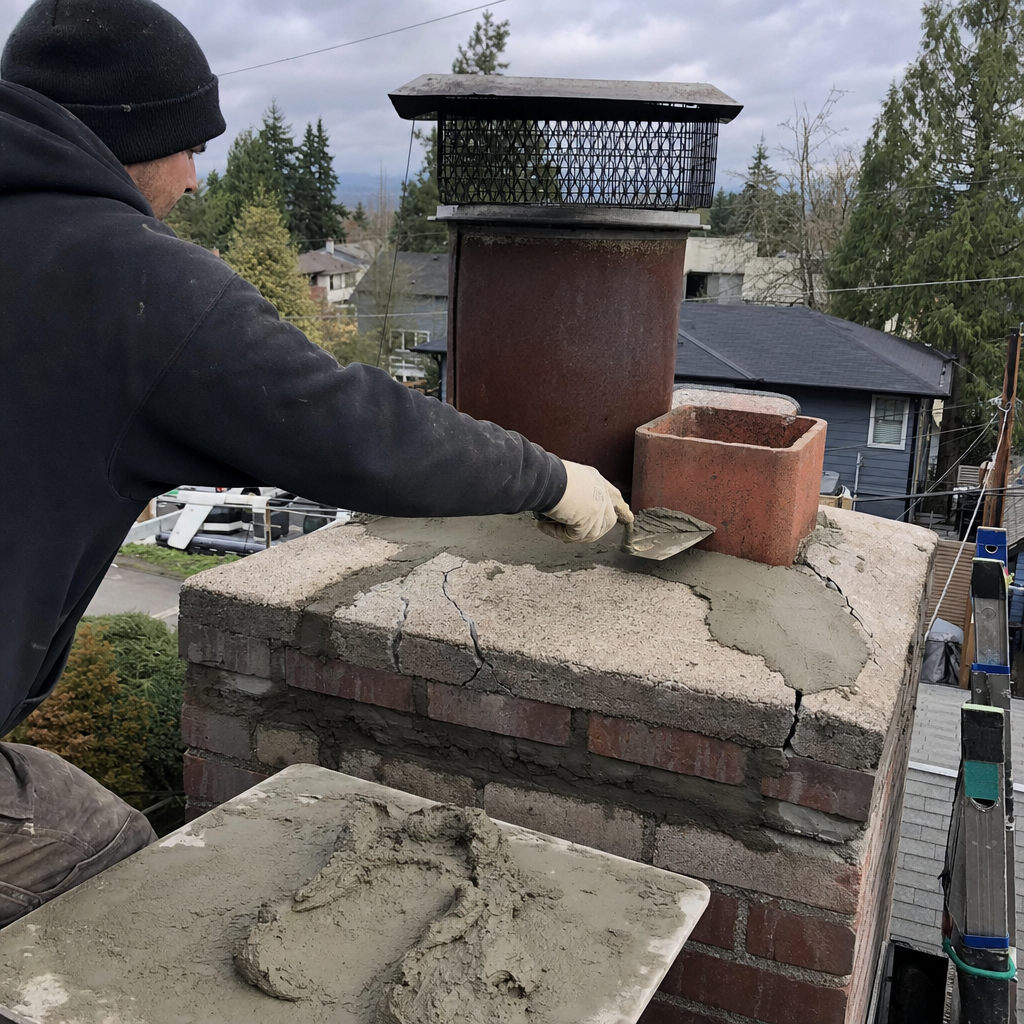
- Inspect the crown and cap. Look for hairline cracks, pooling water, or missing chunks. These are entry points for moisture that will expand when temperatures drop.
- Check flashing where the chimney meets the roof. Seattle’s driving winter rains test this seal; summer is when you can safely repair it.
- Verify your damper seals completely. A leaky damper lets humid summer air into the flue, accelerating rust on metal components and odor issues.
- Schedule major repairs. Crown rebuilding, chimney repair, and liner work done in July or August means you’re ready when October rains and October demand hit simultaneously.
We install caps using Olympia Chimney and Famco hardware specifically because their stainless construction handles Seattle’s salt-air exposure without the corrosion we’ve seen on cheaper imports. A proper cap installation in July prevents thousands in water damage by the following spring.
Fall Prep for a Mild Pacific Northwest Burn Season
Seattle doesn’t have a “heating season” in the Midwestern sense. Our temperatures hover in the 40s and 50s for months. That changes how your chimney performs — and how creosote deposits.
In cold climates, fires burn hot and fast because the house demands heat. In Seattle, homeowners often build smaller, slower fires to “take the chill off.” These low-temperature burns are creosote factories. The smoke cools before it exits, and unburned hydrocarbons condense on flue walls as sticky, highly combustible glaze. We’ve cleaned flues in Ravenna and Wedgwood where the creosote layer looked modest by volume but had the consistency of hardened tar — the most dangerous kind.
Seattle-specific fall preparation:
- Sweep before the first fire, not after. The October booking crunch is real. We start scheduling September sweeps for Seattle customers who understand this timing.
- Test your wood moisture. Seattle’s ambient humidity means even “seasoned” wood often reads 25-30% moisture. Buy a $20 moisture meter. Burn only below 20%. Wet wood in a low-temperature burn is the creosote combination we see most.
- Inspect the firebox for cracked bricks or deteriorated mortar. Heat escapes through these gaps, further cooling the flue and worsening condensation.
- Check that your chimney cap hasn’t clogged with summer debris. Seattle’s bigleaf maples and Douglas fir shed heavily in early fall.
Our chimney cleaning and sweep process includes a video flue inspection that identifies glaze buildup the naked eye misses. After 17 years and over 1,006 verified reviews, we’ve learned that Seattle’s mild burn season hides problems that aggressive cleaning alone won’t solve.
Managing Your Chimney During Seattle’s Shoulder Seasons
March through May and September through October are when Seattle chimneys suffer the most misuse. The temperature swings — 45 degrees and raining Tuesday, 65 and clear Thursday — tempt homeowners into sporadic burning that confuses the chimney system.
Here’s the pattern we diagnose constantly: a fire on a cool April evening, then nothing for two weeks. The flue never reaches stable operating temperature. Creosote deposits in thin, hard layers rather than the fluffy soot that’s easy to brush away. By the time October comes, you’ve got six months of irregular deposits that have hardened into something requiring aggressive mechanical removal.
Shoulder season rules for Seattle homeowners:
- Commit to the fire or don’t light it. A “quick fire” that dies before the flue warms fully deposits more creosote than no fire at all. If you’re not going to burn for at least 90 minutes, use your furnace.
- Build hotter, not bigger. Smaller, well-dried fires with good air intake burn more completely than loaded-up smoldering piles. We teach this technique during every fireplace service call.
- Watch for draft problems on mild days. When outdoor temperature is close to indoor, natural draft is weakest. Smoke spillage into the room is more common in April and October than January. If you smell smoke in the house, extinguish and call — don’t “see if it improves.”
- Don’t assume one annual sweep covers shoulder-season burning. If you burned in April and again in October, that’s two partial seasons with their own deposit profiles.
In our experience across Seattle’s varied topography — from the wind-exposed ridges of Magnolia to the sheltered valleys of Rainier Valley — shoulder season draft behavior varies dramatically. Homes below the ridgeline in neighborhoods like Seward Park often see temperature inversions that stall flue gases. There’s no national guide that accounts for this local microclimate effect.
Spring Post-Mortem: Reading the Signs After Your Last Fire
The national model says: sweep in fall, forget until next fall. We say: examine in spring while the evidence is fresh.
After your final fire of the season, your chimney holds a complete record of how it performed. The deposits, discoloration, and wear patterns tell us whether this was a normal year or one that accelerated deterioration. Waiting until fall means those signs degrade — moisture washes away clues, summer repairs the masonry superficially, and we lose diagnostic information.
What to inspect every April:
- Firebox floor and walls. White or gray powder indicates efflorescence — moisture pushing salts through masonry. New cracks wider than a nickel suggest thermal shock from an overfired or improperly built fire.
- Smoke chamber (visible from below with a flashlight). Excessive black, shiny deposits here mean your fires weren’t hot enough for complete combustion — the classic Seattle low-burn pattern.
- Damper operation. If it’s sticky or won’t fully close after a season of heat cycling, the frame may have warped or corroded. A damper that won’t seal costs you conditioned air all summer and invites humidity into the flue.
- Exterior: white staining on brick (efflorescence), missing mortar, or vegetation growth. Any plant rooting in mortar joints means water is present consistently enough to support life — that’s active moisture intrusion, not cosmetic aging.
- Cap and crown condition post-winter. Seattle’s winter rain followed by occasional freeze cycles test these components harder than our mild temperatures suggest.
Spring is also when we perform our most revealing video inspections. The flue is dry, deposits are stable, and we can distinguish between active damage and old scars. We’ve caught liner failures in West Seattle homes in April that would have been invisible — and dangerous — by the time September scheduling opened up.
When Twice-Yearly Sweeping Actually Makes Sense
The chimney industry has an incentive to sell more sweeps. We’re telling you when it’s genuinely necessary versus when you’re being upsold.
Twice-yearly sweeping is justified when:
| Burn Volume | Indication | Seattle Context |
|---|---|---|
| 3+ cords of wood per season | Heavy use, likely glaze buildup | Primary heat source in older homes without ductwork |
| Pine or softwood burning | Higher creosote production per cord | Common in homes burning windfall from Seattle’s urban forest |
| 24/7 fireplace use during cold snaps | Sustained low flue temperatures | January 2024 freeze events, older homes in Central District |
| Previous chimney fire history | Compromised flue liner, altered surface texture | More common than homeowners admit; often undiagnosed “puffing” events |
| New appliance or fuel change | Unknown deposit pattern with new system | Gas insert retrofits in original fireplaces, increasingly common in Capitol Hill |
Once-yearly is sufficient when:
- You burn fewer than 1.5 cords of properly seasoned hardwood
- Your fires are occasional aesthetic burns, not primary heat
- Last inspection showed minimal glaze with standard soot
- You’re running a gas fireplace with proper venting (still needs annual inspection, but typically lighter cleaning)
We’ve turned down second-sweep requests from Seattle customers whose flues were genuinely clean. The 1,006 reviews we’ve earned at 4.8 stars include specific mentions of this honesty — it’s how James Wilson built the business. If you’re unsure where you fall, a spring inspection lets us measure actual deposit rates rather than guessing.
Seattle Neighborhoods Where Chimneys Age Faster
Not all Seattle chimneys face identical conditions. After nearly two decades of service across the city, we’ve identified patterns tied to local geography and housing stock.
Accelerated aging zones:
- Queen Anne and Capitol Hill (pre-1940 masonry): Original lime mortar, no damp-proofing, often unlined flues. These chimneys absorb Seattle’s moisture like wicks. We’ve rebuilt crowns on 1920s homes in these neighborhoods that had failed completely while identical construction in drier Eastern Washington remained sound.
- Ballard and Fremont (exposed western ridges): Wind-driven rain hits harder here. Caps blow off more frequently; lateral moisture intrusion is more common than simple top-down leaks.
- West Seattle and Alki (salt air exposure): Stainless components corrode faster. We specify Copperfield and DuraFlex liner materials in these areas for their salt resistance — standard galvanized hardware fails prematurely.
- Rainier Valley and Beacon Hill (soil movement): Chimney settlement and separation from structure is more common. Cracks that start structural become water entry points within a season.
- Laurelhurst and Windermere (mature tree canopy): Organic debris accumulation, blocked caps, and the moisture retention of shaded masonry. These chimneys stay wet longer after rain.
Understanding your neighborhood’s specific risk profile changes how you prioritize seasonal tasks. A Ballard homeowner should inspect cap security monthly during wind season. A West Seattle homeowner should check stainless components for pitting annually. Generic advice misses these distinctions.
Common Mistakes to Avoid
- Waiting for “chimney sweep season” in October. By then, Seattle’s first rains have arrived, every reputable sweep is booked two weeks out, and you’re burning with an uninspected flue. Schedule August or early September.
- Assuming gas fireplaces need no maintenance. Seattle’s moisture still attacks exterior components. Venting systems accumulate debris. Ceramic logs degrade and can block proper flame pattern. Annual inspection matters regardless of fuel type.
- Using the “chimney cleaning log” as a substitute for sweeping. These products loosen deposits slightly but leave them in the flue. We’ve removed hardened, chemically altered creosote that’s more difficult to clean than natural deposits. They’re a supplement, not a replacement.
- Ignoring the smell. A musty or sharp odor from the fireplace in summer means moisture and likely organic growth in the system. It’s not “just how old chimneys smell” — it’s active damage you can stop.
- Hiring based on the lowest quote without verifying scope. A “$99 sweep” that doesn’t include video inspection, doesn’t access the roof to check the crown, and doesn’t provide written condition documentation isn’t comparable to comprehensive service. We’ve been called to repair damage missed by cut-rate sweeps in Northgate and Greenwood.
- DIY sweeping without understanding flue construction. Seattle’s older homes often have unlined clay flues, damaged liners, or hidden structural issues. A metal brush in a compromised flue can cause damage you’ll discover when smoke enters your bedroom. High-tension spring systems and ladder work at height carry genuine injury risk — this is trained professional work.
- Burning construction debris or driftwood. Pressure-treated lumber releases arsenic compounds. Salt-cured driftwood from Puget Sound beaches releases corrosive chlorides that destroy stainless liners. We’ve replaced DuraFlex liners prematurely because of this exact practice in beach-access neighborhoods.
When to Call a Professional
Some conditions require immediate professional assessment — not next-season scheduling, not “keeping an eye on it.” Call for same-week service if you notice smoke entering living spaces during normal operation, visible cracks in the flue liner or firebox brick, a chimney fire event (loud roaring, dense smoke, sparks from the top), or water actively dripping into the fireplace or surrounding walls.
Annual professional inspection is non-negotiable for any actively used wood-burning system, and strongly advised for gas fireplaces with shared venting. Horizon Chimney Sweep Washington offers free estimates in Seattle — call (866) 541-8697. James Wilson serves as lead technician, bringing 17 years of chimney-exclusive diagnostic experience to every assessment. We’ve handled full-spectrum work from routine maintenance to complete rebuilds, so if inspection reveals deeper issues, there’s no need to coordinate a second company.
Frequently Asked Questions
Chimney sweeping in Seattle typically ranges from $200–$350 for a standard wood-burning fireplace with Level 1 inspection, with Level 2 video inspections running $300–$500 depending on roof access difficulty and flue configuration. Homes in steep-roof neighborhoods like Queen Anne or with exterior chimney runs may fall at the higher end. Call (866) 541-8697 for an exact quote — estimates are free and include specific scope documentation.
You can, but you shouldn’t — especially in Seattle where mild temperatures encourage low-temperature burns that deposit hazardous glaze creosote. If you’ve burned even a dozen fires without inspection, schedule immediate service rather than assuming “it’s probably fine.” We’ve removed flue-blocking deposits from Seattle homes that burned “just occasionally” all winter.
Summer chimney odor in Seattle usually means moisture has activated organic deposits in the flue — creosote combines with humidity to produce sharp, acrid smells. It can also indicate water intrusion carrying mold or mildew. A sealed damper and proper cap help, but persistent odor needs professional evaluation to distinguish between cleanable deposits and active moisture problems requiring repair.
Localized damage in an otherwise sound liner can often be repaired with HeatShield cerfractory sealant or stainless sleeves, typically 40–60% less than full replacement. However, if the liner is extensively cracked, improperly sized for the appliance, or made of deteriorated clay tile in a multi-story flue, replacement with a DuraFlex or Olympia Chimney stainless system is the durable choice. We evaluate both options during video inspection and quote accordingly — no pressure toward the more expensive path.
A functional chimney cap prevents water entry, blocks animal intrusion, and allows proper venting without restricting draft. In Seattle specifically, check that the cap overhangs the crown edge (not flush with it), that mesh sides are intact without rust-through, and that it’s securely flashed to the flue tile — not merely sitting on top. Caps we install using Famco and Copperfield components include proper overhang design; many original caps on Seattle homes do not.
We carry common repair materials and can often address cap replacement, minor crown sealing, and damper adjustments during the same visit. Major work like liner replacement or rebuilds requires scheduling, but our truck stock and 17 years of preparation mean we minimize return trips. For urgent safety issues discovered during inspection, we’ll secure the system same-day and schedule repair at your earliest convenience.
The Bottom Line
Seattle’s chimney calendar runs opposite to national advice: summer is for active prevention, fall is for verification before burning, shoulder seasons demand disciplined burning practices, and spring is for honest assessment while evidence remains. The homeowners we see with the healthiest, longest-lasting chimneys treat maintenance as a year-round practice tied to local weather patterns, not a single autumn appointment. After 17 years exclusively in this trade and over 1,006 verified customer reviews, we’ve learned that pattern recognition — knowing what Seattle’s specific climate does to specific chimney types — matters more than any generic checklist.
Ready to schedule your seasonal chimney service? Call Horizon Chimney Sweep Washington at (866) 541-8697 for a free estimate. James Wilson serves as lead technician, bringing hands-on diagnostic experience to every Seattle home we serve — from routine sweeps to complete rebuilds, with no subcontractor surprises.
Written by James Wilson, Owner & Lead Technician at Horizon Chimney Sweep Washington, serving Seattle since 2009.