
Last updated July 11, 2026
Chimney Cleaning & Sweep Maintenance Checklist for Seattle Homeowners
Here’s the problem with every generic chimney checklist you’ll find online: it was written for a dry climate with hard freezes and predictable burn seasons. Seattle’s maritime weather pattern—eight months of moisture, mild winters, and homeowners who fire up the hearth only when temperatures dip below 40 degrees—creates a completely different risk profile. In our 17 years of chimney work across Seattle, we’ve pulled liners clogged with condensation sludge, rebuilt crowns devoured by moss, and documented efflorescence patterns that Midwest checklists don’t even mention. This guide covers the maintenance routine James Wilson actually runs through on every Horizon job, tailored to how Seattle homes burn, breathe, and deteriorate.
Quick Answer
Seattle homeowners should inspect their chimney three times yearly: pre-season (September) for moss, efflorescence, and liner condensation damage; mid-season (January) for draft changes and creosote buildup; and post-season (March) for moisture sealing and documentation. Annual professional sweeping with a camera inspection is essential, but the specific timing and warning signs differ significantly from drier climates due to Seattle’s persistent moisture and intermittent burning patterns.
Table of Contents
- Pre-Season Checklist: What to Inspect Before First Fire
- Mid-Season Warning Signs That Can’t Wait
- Post-Season Tasks: Sealing Out Seattle’s Wet Summer
- What You Can Check Yourself vs. What Requires a Camera
- How to Document Your Chimney Year-Over-Year
- Seattle-Specific Risks: Moss, Condensation, and Efflorescence
- What Professional Maintenance Costs in Seattle
- Common Mistakes to Avoid
- When to Call a Professional
- Frequently Asked Questions
Pre-Season Checklist: What to Inspect Before First Fire
In Seattle, “pre-season” means late September or early October—before the first sustained cold snap sends everyone scrambling for appointments. After 17 years of September scheduling rushes, we can tell you: the homeowners who inspect in late summer get priority slots and catch problems before they become dangerous.
Here’s the pre-sequence James Wilson runs through on every Horizon pre-season evaluation:
- Exterior crown and cap inspection from ground level. In Seattle’s climate, crown deterioration accelerates dramatically. Look for moss or small vegetation—yes, actual plants—growing in cracks. We’ve found ferns sprouting from neglected crowns in Ravenna and Ballard. Moss holds moisture against masonry, accelerating freeze-thaw damage even in our mild winters.
- Efflorescence check on exterior brick or stone. That white, chalky residue is soluble salts pushed out by moisture migration. In Seattle’s persistent damp, efflorescence indicates water is moving through the masonry system—often from failed crown sealing, deteriorated mortar joints, or liner condensation finding paths outward. Document the location; expanding efflorescence patterns signal advancing water intrusion.
- Flashing and roofline seal inspection. Seattle’s driving winter rains exploit any gap. Look for lifted flashing, separated sealant, or water staining on the ceiling near the chimney breast. In our experience, Queen Anne and Capitol Hill homes with original metal flashing see the most seasonal separation as thermal cycling loosens fasteners.
- Damper operation and visual check. Open fully, close fully, inspect the visible throat. Look for rust, warping, or tar-like creosote deposits. Seattle’s intermittent burning—many homeowners fire up only 20-30 days yearly—actually concentrates creosote in a narrower band, making visual identification easier but no less dangerous.
- Firebox and hearth visual inspection. Cracked firebrick, deteriorated mortar, or shifted hearth sections need professional evaluation before firing. Gas log sets require specific attention to burner port corrosion from salt air in waterfront neighborhoods like Alki and Magnolia.
Pre-season is also when we recommend scheduling your professional sweep. Chimney Cleaning & Sweep in Dishman and throughout Seattle fills fast once temperatures drop. A camera inspection during this appointment reveals liner conditions no ground-level check can assess.
Mid-Season Warning Signs That Can’t Wait
Seattle’s burn season typically runs November through February, with peak usage in December and January. Mid-season indicators that your chimney needs immediate attention—before your scheduled annual sweep—include:
- Draft changes or smoke spillage. If fires that drafted perfectly in November now push smoke into the room, suspect creosote narrowing, a blocked cap from wind-driven debris, or—critical in Seattle—moisture-saturated flue gases reducing upward draw. We’ve diagnosed dozens of “sudden” draft failures in Greenwood and Fremont that traced to liner condensation pooling and partially blocking the flue.
- Unusual odors, especially when not in use. A sour, acrid smell from the fireplace when dormant indicates moisture-activated creosote compounds or—more seriously—animal intrusion. Seattle’s raccoon and squirrel populations seek warm chimney cavities in January; a cap inspection is urgent.
- Visible tar or shiny black deposits at the damper. This is stage-three creosote, highly combustible and requiring immediate professional removal. Seattle’s cool, moist fires (insufficient preheating, damp fuel) produce this concentrated deposit faster than hot, dry burns.
- Water in the firebox. Any moisture presence during burn season signals crown, flashing, or liner failure. Do not operate until evaluated—steam expansion in heated masonry causes accelerated deterioration.
Our 1,006 verified reviews reflect repeated mid-season emergency calls that homeowners initially delayed. The pattern is consistent: small symptoms ignored in December become expensive repairs by March. When in doubt, call before the next fire.
Post-Season Tasks: Sealing Out Seattle’s Wet Summer
After your final fire—typically late February or March in Seattle—specific post-season tasks prevent the moisture intrusion that dominates our eight-month wet period.
- Close and seal the damper tightly. An open damper creates a direct moisture chimney from roof to hearth. In Seattle’s humid summers, this drives interior condensation on firebox surfaces and accelerates rust on metal components. We recommend a tight damper seal plus a chimney balloon or inflatable draft stopper for additional protection—especially in homes without air conditioning, where stack effect reversal draws moist air downward.
- Remove all ash and debris from the firebox. Ash absorbs atmospheric moisture, becoming corrosive to metal firebox components and fostering odor issues. Complete removal and a light firebrick wipe-down prevents summer mustiness.
- Inspect and photograph the firebox condition. Post-season documentation—when the system is clean and dry—provides your baseline for year-over-year comparison. Note any new cracking, spalling, or mortar loss.
- Verify cap and spark arrestor integrity. Summer is when small animals nest; a secure cap with intact mesh prevents autumn blockages. In Seattle’s dense tree canopy neighborhoods like Wedgwood and Laurelhurst, summer also brings seed and leaf accumulation that can obstruct mesh screening.
- Schedule any needed repairs before September rush. Crown sealing, flashing repair, or liner evaluation completed in spring or summer avoids the September-October appointment crunch and ensures your system is ready for first fire.
Chimney Repair in Dishman and across Seattle sees predictable spring scheduling for exactly these post-season maintenance needs.
What You Can Check Yourself vs. What Requires a Camera
We’re direct about this: some checks are homeowner-appropriate, others require the diagnostic equipment and training that 17 years of chimney-exclusive work provides.
Safe homeowner inspections (ground level, no tools):
- Visual crown and cap assessment from yard or roof edge—use binoculars, not ladders
- Damper operation and throat visual check
- Firebox and hearth surface condition
- Interior ceiling staining near chimney breast
- Odor identification and documentation
Requires professional evaluation with camera and access equipment:
- Liner condition, including corrosion, spalling, and condensation damage patterns
- Creosote deposit location, volume, and stage classification
- Smoke chamber and flue transition geometry
- Hidden crown deterioration (underside cracks invisible from above)
- Foundation settlement or structural movement indicators
- Combustible clearance verification in concealed construction
The camera inspection is non-negotiable for Seattle homes. Our wet climate creates liner deterioration patterns—particularly stainless steel corrosion at condensation lines and clay tile spalling from freeze-thaw cycling—that are invisible until failure. James Wilson has documented progressive liner damage in West Seattle and Beacon Hill homes that appeared externally sound for years while interior deterioration advanced.
Safety caveat: Never attempt roof-level chimney inspection without proper fall protection and ladder safety training. Steep Seattle roofs, moss-slick surfaces, and unpredictable maritime winds create genuine fall hazards. This is precisely why owner-operator accountability matters—when James Wilson is at the door, he’s evaluating access safety personally, not delegating to untrained labor.
How to Document Your Chimney Year-Over-Year
One of the most valuable services we provide isn’t cleaning—it’s pattern recognition. After 17 years and over a thousand Seattle chimneys, we’ve learned that documented deterioration trends predict failure before it becomes visible or dangerous.
Here’s the documentation system we recommend:
- Annual photograph set. Same angles, same lighting, same season. Minimum: exterior full-height, crown close-up, firebox interior, damper throat, and any noted anomalies. Store with date and weather conditions.
- Written condition log. Note efflorescence location and extent, crack dimensions (measure with ruler, photograph with scale), mortar joint depth, and any new developments. “Crown crack, 3 inches, south face, first noted October 2023” becomes actionable data.
- Professional inspection report retention. Keep all sweep and inspection documentation. Reputable sweeps provide detailed reports; compare year-over-year for trend identification. We flag progressive changes for homeowner attention during each Horizon visit.
- Repair and material records. Note products used—Gelco caps, Olympia Chimney components, HeatShield resurfacing, Famco hardware, or Copperfield accessories—so future maintenance matches existing systems. Incompatible materials accelerate deterioration.
Documentation transforms reactive maintenance into predictive care. We’ve identified crown degradation trends in documented Seattle homes that allowed preventive sealing—hundreds of dollars—rather than full rebuilds running into thousands.
Seattle-Specific Risks: Moss, Condensation, and Efflorescence
This section covers what generic checklists miss entirely—conditions we diagnose weekly in Seattle that would be irrelevant in Denver or Minneapolis.
Moss and vegetation on crowns: Seattle’s maritime climate supports moss growth year-round, with accelerated proliferation on north-facing and tree-shaded chimneys. Moss roots penetrate microscopic crown cracks, expanding them through freeze-thaw cycling. We regularly remove substantial moss mats from crowns in neighborhoods like Phinney Ridge and Bryant where tree canopy density creates persistent shade. Prevention requires crown sealing with breathable, flexible products—not paint or non-breathable coatings that trap moisture.
Liner condensation damage: This is uniquely severe in Seattle due to our intermittent burning pattern. A flue that runs cold for 330 days yearly never develops the sustained temperatures that keep liners dry. Condensation accumulates, mixes with combustion acids, and creates corrosive solutions that attack stainless steel and accelerate clay tile spalling. We’ve replaced DuraFlex liners in Seattle homes where condensation-line corrosion reduced wall thickness by 50% in under eight years—far faster than manufacturer projections for dry-climate installations.
Efflorescence progression: That white staining isn’t merely cosmetic. It indicates active water migration through masonry, carrying soluble salts to the surface. In Seattle’s persistent damp, efflorescence signals either failed crown waterproofing, compromised flashing, or liner condensation finding exterior paths. Tracking efflorescence location and intensity year-over-year reveals whether your moisture management is improving or failing.
Fireplace Services in Dishman and throughout Seattle must address these climate-specific factors to provide lasting solutions.
What Professional Maintenance Costs in Seattle
Pricing transparency matters for trust. Here’s what Seattle homeowners can expect for professional chimney maintenance, based on our 17 years of market experience:
| Service | Typical Range | Notes |
|---|---|---|
| Level 1 sweep with basic inspection | $180 – $280 | Standard annual maintenance for systems with no changes |
| Level 2 inspection with camera | $280 – $450 | Required for real estate transactions, post-event evaluation, or suspected damage |
| Crown sealing/repair | $350 – $850 | Depends on crown construction (poured concrete vs. preformed) and access difficulty |
| Cap replacement (standard Gelco/Olympia Chimney) | $250 – $550 | Includes proper sizing and animal-proof mesh |
| Firebox refractory repair | $400 – $1,200 | HeatShield or similar refractory restoration for cracked panels |
| Stainless liner installation (DuraFlex) | $2,800 – $5,500 | Varies with flue height, diameter, and connection complexity |
These ranges reflect Seattle’s labor market and access challenges—steep roofs, tight lots, and parking constraints in dense neighborhoods. Horizon Chimney Sweep Washington home provides exact quotes after evaluation; estimates are free.
Common Mistakes to Avoid
- Assuming “I don’t use it much” means low risk. Seattle’s intermittent burning actually concentrates creosote in specific flue zones and creates more severe condensation patterns than daily use. Infrequent fires are not low-maintenance fires.
- Ignoring moss as “just Seattle character.” Moss on crowns is active structural damage in progress. We’ve rebuilt crowns in Magnolia where moss penetration created through-cracks allowing direct water entry to the flue system.
- Using the fireplace when the damper doesn’t fully open. This seems obvious, but mid-season damper corrosion from summer moisture accumulation causes partial seizure. Forcing operation creates smoke spillage and carbon monoxide exposure risk.
- Scheduling sweeps in peak season without pre-inspection. September and October appointment availability compresses dramatically. Homeowners who discover pre-existing damage during a scheduled sweep face delayed repairs or unsafe operation through early cold periods.
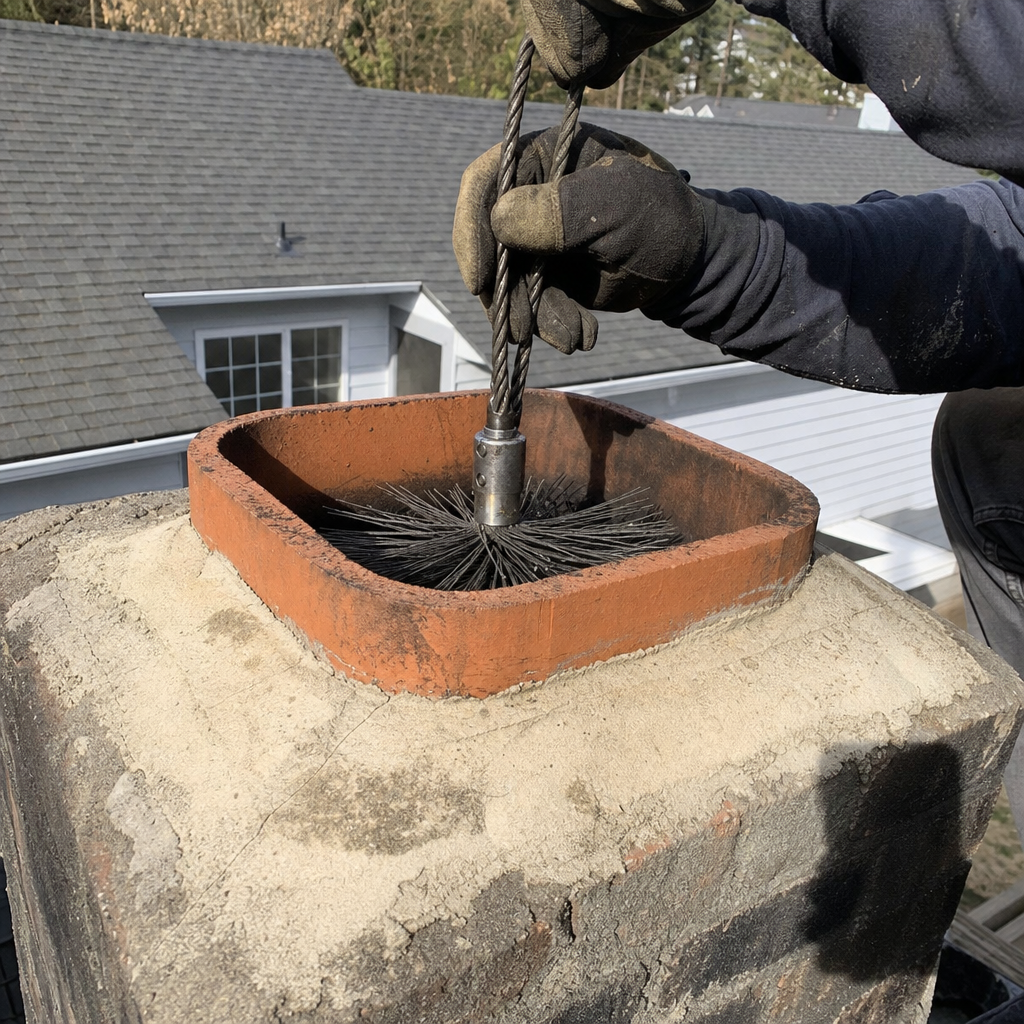
- DIY creosote removal with chemical logs or brushes. Chemical logs modify creosote but don’t remove it; improper brushing damages liner surfaces. Professional mechanical removal with appropriate tools for your liner type is essential.
- Neglecting gas fireplace annual service. Seattle homeowners often assume gas systems are “maintenance-free.” Corroded burner ports, deteriorated log placement, and venting issues create real hazards. Annual inspection is equally critical.
When to Call a Professional
Call immediately if you observe: water in the firebox during burn season; smoke spillage into living spaces; unusual odors accompanied by draft failure; visible exterior masonry displacement or leaning; or any post-storm damage to cap or flashing. These conditions indicate active safety hazards requiring professional evaluation before further use.
For routine maintenance, schedule your annual sweep and camera inspection in late summer for optimal availability and pre-season readiness. Horizon Chimney Sweep Washington offers free estimates in Seattle—call (866) 541-8697 to speak with James Wilson directly about your chimney’s condition and schedule a convenient evaluation time.
Frequently Asked Questions
Annual professional sweeping with camera inspection is the minimum for Seattle homes, regardless of apparent usage. Our wet climate and intermittent burning patterns create condensation and creosote conditions that exceed visual assessment capability. Call (866) 541-8697 for scheduling—estimates are free.
Repair is typically 40-60% less expensive than full replacement when damage is localized and caught early. However, Seattle’s condensation corrosion often affects extended liner sections, making replacement with properly specified DuraFlex or equivalent the more cost-effective long-term solution. We evaluate each case individually—call for a camera inspection and exact quote.
Light moss removal and sealing can often be completed in a single visit. Extensive crown deterioration requiring rebuild or resurfacing with HeatShield or similar products typically requires scheduling for proper curing conditions. Call (866) 541-8697 to discuss your specific situation.
Summer chimney odor typically indicates moisture-activated creosote compounds, animal intrusion, or damper seal failure allowing humid air migration. Seattle’s high summer humidity amplifies all three. A tight damper seal and professional evaluation of creosote load usually resolves persistent odor issues.
Seattle’s chimney maintenance runs 15-25% above national averages due to labor costs, access challenges on steep lots, and the additional moisture-management measures our climate requires. However, preventive maintenance remains far less expensive than the fire damage or structural repairs that result from neglect.
Ground-level visual checks of crown, cap, and interior firebox are appropriate homeowner inspections. Any roof-level evaluation, flue interior assessment, or suspected structural issue requires professional equipment and training. Seattle’s steep, often moss-slick roofs create genuine fall hazards that professional sweeps are equipped to manage safely.
The Bottom Line
Seattle chimney maintenance demands a checklist built for maritime moisture, intermittent burning, and moss-accelerated deterioration—not generic guidance from drier climates. The three inspection windows (pre-season, mid-season, post-season), specific attention to condensation and efflorescence, and disciplined year-over-year documentation separate preventive homeowners from those facing emergency repairs. With 17 years of Seattle-specific pattern recognition and over 1,006 verified reviews, we’ve refined this checklist through repeated application across every neighborhood from Ballard to Beacon Hill. The investment in proper maintenance—typically under $300 annually for standard service—protects against the $3,000-$8,000 repairs that deferred maintenance inevitably produces in our wet climate.
Written by James Wilson, Owner & Lead Technician at Horizon Chimney Sweep Washington, serving Seattle since 2009.