
Last updated July 11, 2026
Chimney Cleaning Permits, Codes & Inspections in WA: What You Need to Know
Your chimney sweep found a cracked liner and quoted a reline job. What almost no one tells you: in Washington, that repair may require a building permit — and skipping it could void your homeowner’s insurance claim if something goes wrong. After 17 years cleaning chimneys across Seattle, from Ballard’s century-old Craftsman homes to newer builds in West Seattle, we’ve watched too many homeowners get blindsided by this gap between routine maintenance and code-governed repairs. This guide draws the line clearly: what’s just a sweep, what triggers permits, and how to protect yourself before you sign the final invoice.
Quick Answer
Routine chimney cleaning and sweeping in Washington State generally does not require a permit. However, structural repairs, liner replacements, chimney rebuilds, and alterations to clearances or venting systems typically do require permits under local building codes. Insurance companies increasingly require documentation of permit compliance and professional inspection reports for claims related to chimney fires or carbon monoxide incidents.
Table of Contents
- What Chimney Work Actually Requires Permits in Washington?
- What the International Residential Code Says — In Plain Language
- How Spokane County and King County Permit Rules Differ
- Why Insurance Companies Now Demand Inspection Reports
- How to Verify Code Compliance Before You Pay
- How Seattle’s Wet Climate Affects Chimney Code Requirements
- Common Mistakes to Avoid
- When to Call a Professional
- Frequently Asked Questions
- The Bottom Line
What Chimney Work Actually Requires Permits in Washington?
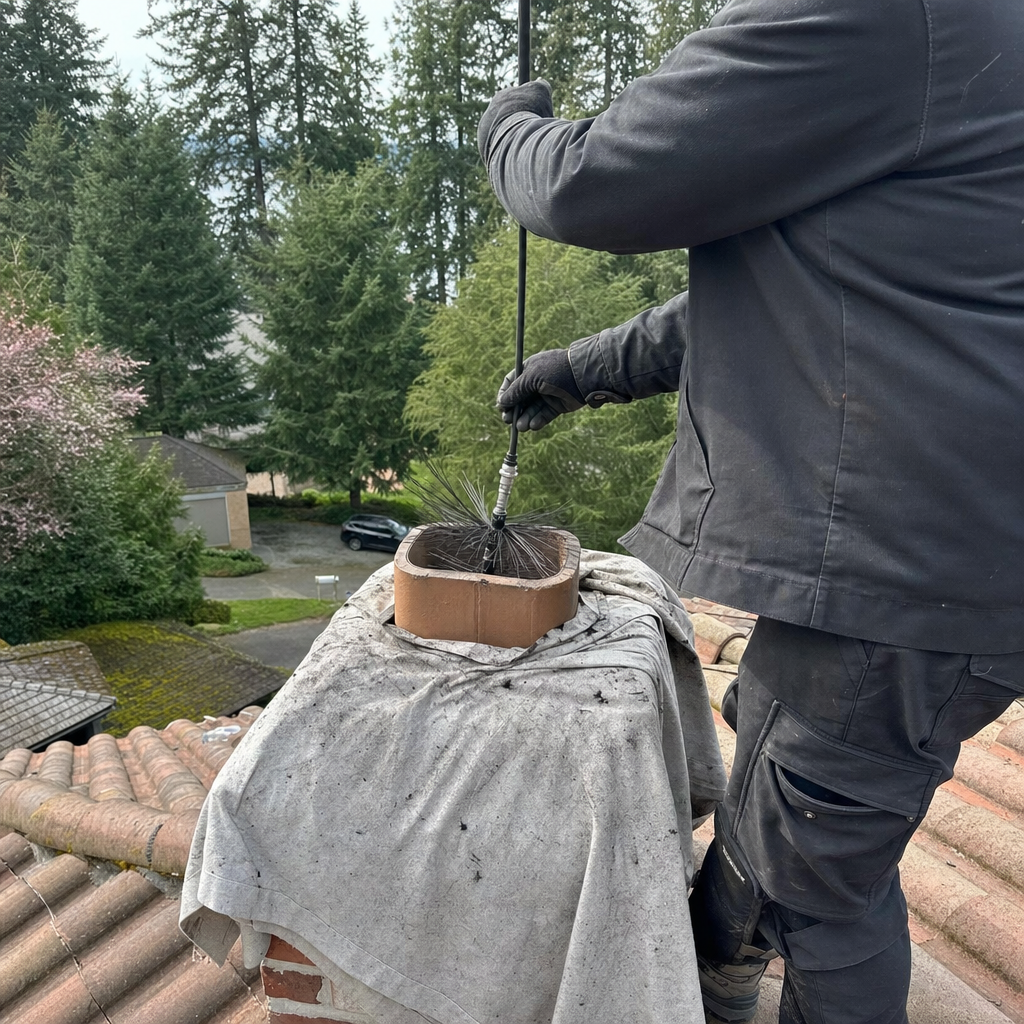
Here’s where homeowners get tripped up. The sweep itself — brushing creosote from flue walls, inspecting with a camera, cleaning the firebox — falls under routine maintenance. No permit needed. But the moment your technician discovers damage that requires alteration to the structure, materials, or venting path, you’ve crossed into permit territory.
Typically permit-exempt (routine maintenance):
- Annual chimney sweeping and creosote removal
- Visual and camera inspections of flue condition
- Fireplace damper adjustment or replacement (same location, same specs)
- Chimney cap cleaning or like-for-like replacement
- Smoke chamber parging with listed materials (in many jurisdictions)
Typically permit-required (structural or system changes):
- Chimney liner installation or replacement (stainless steel, aluminum, or cast-in-place)
- Chimney rebuilds, partial or complete
- Crown replacement that alters dimensions or drainage
- Clearance reductions using heat shields or engineered solutions
- Conversion from wood-burning to gas insert or vice versa
- Through-wall or through-roof venting modifications
- Addition of a new fireplace or stove to an existing system
In Seattle, we’ve handled hundreds of jobs where the initial call was “just a cleaning” and the inspection revealed a failed liner or deteriorated crown. Homeowners in neighborhoods like Queen Anne and Capitol Hill — where pre-1940s masonry is common — face this scenario regularly. The key question isn’t whether you need a sweep; it’s whether the sweep uncovers work that changes your chimney’s structure or safety profile.
Here’s the practical sequence we follow on every job: inspect first, document findings, then discuss whether discovered issues trigger permit requirements before quoting repairs. No surprises, no hidden code obligations after you’ve already committed.
What the International Residential Code Says — In Plain Language
Washington State adopts the International Residential Code (IRC) with state amendments. For chimneys, three IRC sections matter most for homeowners. I’ll translate the code language into what it means for your checkbook and safety.
IRC R1001 — Masonry Chimneys
The code requires masonry chimneys to be lined with approved materials and maintained free of cracks, gaps, or deterioration that could allow combustion gases to escape into living spaces. In plain terms: if your clay flue tiles are cracked, spalled, or missing chunks, your chimney doesn’t meet code regardless of how “well it’s always worked.” We’ve pulled out shattered tile sections in Seattle homes where the homeowner had no idea — the cracks were above the roofline, invisible from below.
IRC R1003 — Chimney Clearances
Combustible materials must stay at least 2 inches from the exterior of masonry chimneys, with specific path requirements for framing, trim, and roofing. The 2-inch rule gets violated constantly in older Seattle homes where previous owners built decks, added siding, or enclosed chimneys during renovations. We see this in Wallingford and Fremont regularly — charming additions that encroach on chimney clearance and create latent fire hazards.
IRC R1005 — Factory-Built Chimneys
Metal chimney systems must be installed per manufacturer’s listing and never modified with unapproved parts. That “great deal” chimney cap from a big-box store? If it’s not listed for your specific chimney brand, it’s a code violation. We install Gelco and Olympia Chimney caps specifically because they’re listed for compatibility with major factory-built systems — not because they’re flashy, but because they keep installations compliant.
Washington State amendments add:
- Seismic bracing requirements for chimneys in earthquake zones — relevant throughout Western Washington
- Enhanced clearance rules for homes in wildland-urban interface areas
- Specific documentation requirements for wood stove installations
The IRC doesn’t dictate who does the work, but it does specify how the work must be done. That’s where professional judgment and documented compliance become essential.
How Spokane County and King County Permit Rules Differ
Washington delegates permit authority to local jurisdictions, and chimney work sees significant variation between eastern and western Washington’s largest markets.
Spokane County (including Dishman, Spokane Valley, and unincorporated areas)
Spokane County Building and Planning Services requires permits for:
- All chimney liner replacements (mechanical permit)
- Chimney rebuilds exceeding 25% of existing structure (building permit)
- Wood stove and fireplace insert installations (mechanical permit plus fire district notification)
- Any work involving gas line modifications (separate plumbing permit)
Spokane’s drier climate means less freeze-thaw damage to masonry, but wood stove usage is higher per capita than Seattle. The Spokane Fire Department actively enforces wood stove installation permits and may require post-installation inspection. We’ve worked with Spokane-area homeowners who faced delayed insurance claims because their wood stove installation lacked the required fire district sign-off — a separate step from the building permit itself.
King County / Seattle
Seattle’s Department of Construction and Inspections (SDCI) governs permits within city limits, while unincorporated King County falls to the Department of Local Services, Permitting Division. Key differences:
- Seattle SDCI requires permits for all liner replacements, including like-for-like swaps
- King County generally exempts “repair or replacement of existing equipment in kind” but requires permits for material changes (stainless steel replacing clay, for example)
- Seattle mandates seismic bracing documentation for chimney work in pre-1950s construction
- Both jurisdictions require licensed mechanical contractors for gas appliance connections
In Seattle specifically, historic district overlays in neighborhoods like Pioneer Square and Capitol Hill add Landmark Preservation Board review for exterior-visible chimney modifications. We’ve navigated this process for crown rebuilds on designated structures — it adds 2-3 weeks but protects homeowners from retroactive compliance orders.
The practical takeaway: never assume your jurisdiction handles permits like the next county over. A sweep who’s worked exclusively in Seattle may not know Spokane’s fire district notification requirement, and vice versa. We maintain current permit checklists for every jurisdiction we serve.
Why Insurance Companies Now Demand Inspection Reports
This shift has accelerated dramatically. Five years ago, chimney fire claims rarely faced documentation challenges. Today, major underwriters routinely request:
- Pre-incident inspection reports — proof the chimney was maintained and any known defects were addressed
- Permit documentation for any repairs or modifications within the policy period
- Technician credentials — CSIA certification, NFI credentials, or equivalent documented training
- Photo and video documentation of flue condition before and after work
The reason is straightforward: chimney fires generate expensive claims (average $8,000–$15,000 in structural damage, plus smoke remediation), and insurers have learned that unmaintained systems or unpermitted modifications correlate strongly with loss severity.
We’ve assisted Seattle homeowners in the University District and Green Lake with insurance documentation after claims. The pattern is consistent: policyholders with dated inspection reports from CSIA-certified sweeps experience smoother claims processing. Those without documentation face adjuster skepticism, delayed payments, and in some cases, coverage disputes alleging negligence.
What satisfies most underwriters:
- Annual inspection per NFPA 211 Standard (Level 1 for maintained systems, Level 2 for real estate transactions or known changes)
- Written condition assessment with photo/video evidence
- Clear recommendations with timelines (“repair recommended within 12 months”)
- Documentation of completed repairs with permit numbers where applicable
- Technician certification numbers and company information
Our inspection reports include all of these elements by default. After 1,006 verified reviews and 17 years of documentation, we’ve refined the format that adjusters recognize and accept. It’s not about padding the invoice — it’s about protecting your coverage.
How to Verify Code Compliance Before You Pay
Homeowners often feel powerless evaluating technical work. You shouldn’t. Here’s a practical verification sequence we encourage every client to follow:
Step 1: Request the permit number before work begins
For any repair beyond routine sweeping, ask: “Will this require a permit, and if so, who’s pulling it?” Reputable contractors handle this transparently. In Seattle, you can verify permit status at Horizon Chimney Sweep Washington home — though we always provide permit numbers directly.
Step 2: Confirm the scope matches the permit
A permit for “chimney liner replacement” doesn’t cover crown rebuild or damper modification. Cross-reference the approved scope with your written quote.
Step 3: Request final inspection documentation
Jurisdictions issue completion certificates or inspection sign-offs. Obtain a copy before final payment. In King County, this is often digital; Spokane County still issues paper certificates in many cases.
Step 4: Verify materials match code listings
For liners, ask for the UL listing sheet. For caps, confirm manufacturer and model. We use Famco and Copperfield components specifically because their listings are readily verifiable — no guessing whether a part meets code.
Step 5: Retain records with your homeowner’s insurance file
Digital copies suffice. The goal is immediate accessibility if you ever need to demonstrate compliance.
In 17 years, we’ve encountered exactly two instances where previous contractors’ “completed” work lacked required permits. Both cases required costly remediation. Verification isn’t paranoia — it’s due diligence that protects your property value and safety.
How Seattle’s Wet Climate Affects Chimney Code Requirements
Seattle’s 37+ annual inches of rainfall create chimney conditions that drier regions simply don’t face. This isn’t just maintenance frequency — it’s code-relevant deterioration that changes how chimneys age and what repairs become necessary.
Freeze-thaw cycling in masonry
While Seattle’s winters are milder than Spokane’s, repeated wet-dry and limited freeze-thaw cycles degrade mortar joints and crown integrity. IRC R1001’s requirement for “sound masonry” gets tested faster here than in arid climates. We’ve rebuilt crowns in Magnolia and Madrona where water infiltration accelerated deterioration by a decade compared to inland equivalents.
Chimney cap and crown specifications
Seattle’s sustained moisture means crown slope and overhang specifications matter more. A flat or improperly sloped crown — technically “existing” and grandfathered — fails faster and creates cascading damage. When we rebuild crowns, we specify minimum 4-inch overhang and engineered slope to shed water aggressively. HeatShield crown coatings provide additional waterproofing for suitable substrates.
Stainless steel liner preference
Washington’s amended IRC doesn’t mandate stainless over aluminum, but Seattle’s marine-influenced corrosion environment makes 316Ti stainless steel the practical standard for wood-burning applications. We specify DuraFlex liners for their corrosion resistance documentation — not because code requires the brand, but because the material specification meets the environmental demand that code’s general language implies.
Clearance to vegetation
Seattle’s dense canopy and rapid plant growth mean chimneys near mature trees require vigilant clearance maintenance. While not strictly a code issue for existing construction, vegetation contact accelerates moisture retention and creates fire hazards that affect insurance assessments.
Common Mistakes to Avoid
- Assuming “just a cleaning” covers everything. The sweep is maintenance; discovered damage requires separate evaluation and possibly permits. We separate these explicitly in our proposals so Seattle homeowners understand where maintenance ends and repair begins.
- Letting a handyman handle liner replacement. General contractors without chimney-specific expertise routinely miss permit requirements, listing compatibility, and proper sizing. We’ve corrected failed installations in Ravenna and Rainier Valley where the original “savings” cost 40% more to remediate.
- Ignoring permit requirements for “like-for-like” swaps. King County’s exemption for in-kind replacement doesn’t apply if materials change — clay to stainless, for example. Always verify with your jurisdiction before assuming exemption.
- Discarding inspection documentation. That camera inspection video from three years ago? It’s evidence of pre-existing condition if you need to file a claim. Store it with your insurance records, not in your sweep’s file.
- Accepting verbal permit assurances. “Don’t worry, we handle permits” means nothing without a permit number you can verify. In Spokane County especially, we’ve seen contractors claim permit exemption for clearly permit-required work.
- Neglecting post-repair final inspection. Some jurisdictions require it; others don’t. Regardless, request it. The certificate of completion is your proof of code compliance.
- Choosing material based on price alone. Off-brand liners and caps may save $200 upfront and fail to carry required listings. We use specified brands precisely because their documentation supports permit approval and insurance defensibility.
When to Call a Professional
Call when your annual inspection reveals anything beyond surface creosote — cracked tiles, deteriorated mortar, water stains on interior walls near the chimney, or draft problems that don’t resolve with damper adjustment. Call before buying a home with a fireplace, since Washington’s seller disclosure requirements don’t mandate chimney-specific condition reporting. Call after any chimney fire, however minor, since hidden liner damage isn’t visible from below.
In Seattle’s wet climate, call if you notice efflorescence (white mineral deposits) on exterior masonry, which signals water infiltration that will accelerate deterioration. Call if your insurance company requests documentation and your records are sparse — we can perform current-condition inspections that establish baseline compliance.
Chimney Cleaning & Sweep in Dishman and throughout our service area, Horizon Chimney Sweep Washington offers free estimates — call (866) 541-8697. James Wilson serves as lead technician, bringing 17 years of chimney-exclusive expertise to every evaluation, not a rotating subcontractor.
Frequently Asked Questions
No. Annual sweeping, inspection, and basic maintenance like damper adjustment or cap cleaning do not require permits anywhere in Washington State. Permits become necessary when structural repairs, liner replacements, or system modifications are involved. Call (866) 541-8697 to schedule maintenance that keeps you ahead of permit-triggering damage.
Permitted stainless steel liner replacement in Seattle typically ranges from $2,800–$4,500 for a standard masonry fireplace, including permit fees, materials, and installation. Complex installations with multiple flues, offset connectors, or difficult roof access can exceed $5,000. We provide itemized quotes separating permit costs so you see exactly where your investment goes — estimates are free.
A Level 1 inspection covers readily accessible portions of the chimney, appropriate for annual maintenance of systems without known changes. A Level 2 inspection includes camera examination of internal flue surfaces, accessible attic and crawl space evaluation, and documentation suitable for real estate transactions or insurance requirements. We recommend Level 2 for any Seattle home purchase or after structural events like earthquakes.
Homeowners can pull permits for work on their own primary residence in most King County jurisdictions, including Seattle. However, gas appliance connections require licensed mechanical contractors, and many insurers prefer — or require — work performed by certified professionals. We handle permit procurement as part of our repair services to ensure documentation accuracy.
Contact your local building department with your address — permits are public record. Seattle SDCI maintains online records back to the 1990s; older records may require in-person or phone requests. For Chimney Repair in Dishman or Spokane County, check with the Spokane County Building and Planning Services. We verify permit history before beginning any project where previous work might affect our scope.
Most policies don’t explicitly mandate annual inspections, but claims involving chimney fires or CO incidents are increasingly scrutinized for maintenance documentation. Policies with “neglect” exclusions may deny claims where foreseeable deterioration was unaddressed. Annual professional inspection with dated, photo-documented reports provides the strongest claim protection. Call (866) 541-8697 to establish or maintain your documentation.
The Bottom Line
Chimney cleaning itself lives in the maintenance world — no permits, no code complications, just essential fire prevention. But chimneys hide problems that cleaning reveals, and the repairs those problems require often live in the regulated world of permits, inspections, and documented compliance. The homeowners who fare best are those who understand this boundary before they’re standing in their living room with a contractor’s quote in hand. In Seattle’s demanding climate, with insurance scrutiny intensifying, proactive documentation and permit awareness aren’t bureaucratic box-checking — they’re financial and physical protection. Get the inspection. Ask about permits. Keep the records. And when work is needed, choose technicians who navigate this landscape as a matter of course, not as an afterthought.
Written by James Wilson, Owner & Lead Technician at Horizon Chimney Sweep Washington, serving Seattle since 2009.