
Chimney Flashing Repair in Washington, WA — Why the Leak Usually Isn’t Where You Think
Chimney flashing repair in Washington, WA typically costs between $350 and $950 depending on whether you’re addressing sealant failure, counter flashing replacement, or full step flashing rebuild. Most jobs we handle are completed in a single visit. If you’re seeing water stains on your ceiling near the chimney, call us at (866) 541-8697 — we’ll diagnose whether the problem is the flashing itself or the masonry it’s embedded into, and we’ll tell you before we start any chimney repair work.
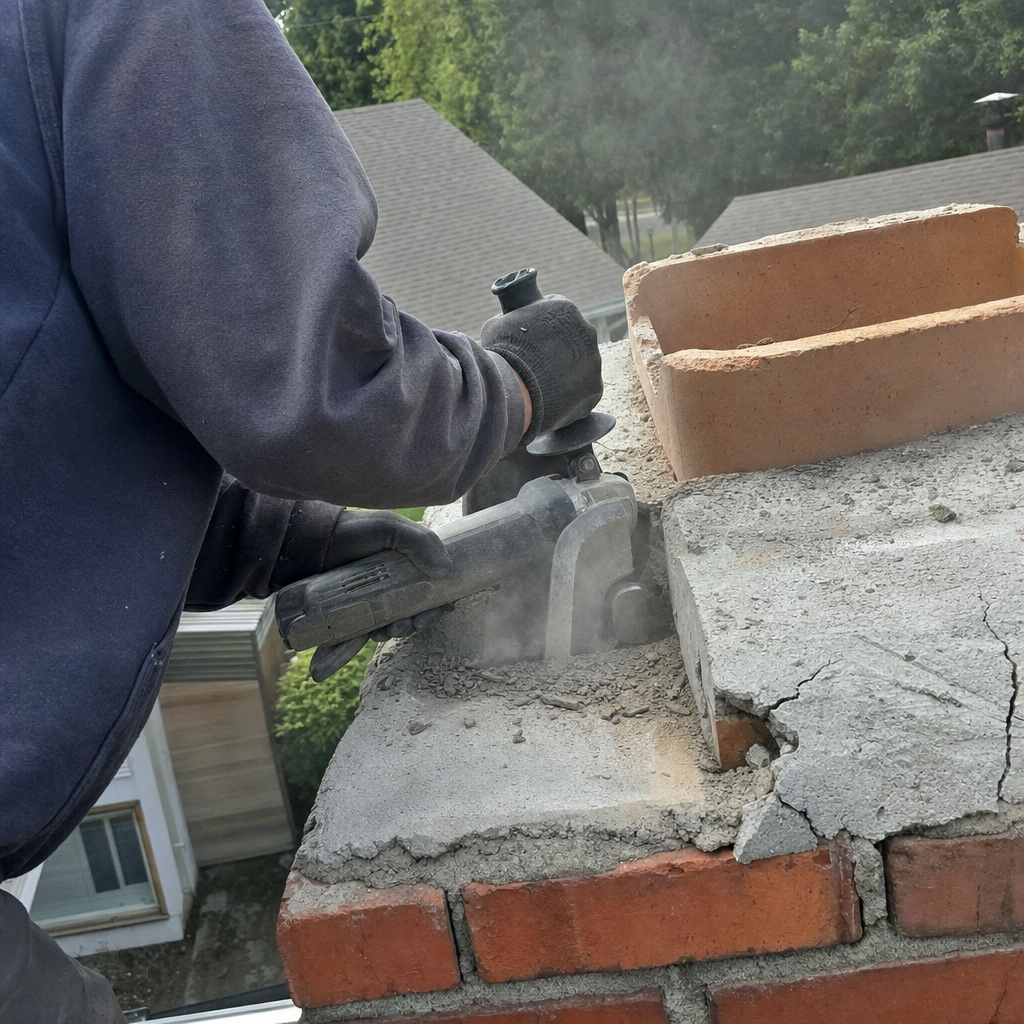
Here’s a pattern we’ve seen so many times in Washington that it’s almost predictable. A homeowner notices water coming through the ceiling near their chimney. They call a roofer. The roofer climbs up, re-caulks the seam where the metal meets the brick, and charges $300–$500. Six months later — usually after the first sustained rain of fall — the stain is back, maybe bigger. The homeowner calls the roofer again. This time the roofer shrugs and says, “Might be a chimney problem.”
They’re half right. The problem is the chimney side of the joint. But by then, water has been running behind the wall for two seasons, and what started as a $400 flashing embed repair has become a $2,000 drywall and framing job.
James Wilson, our owner and lead technician, has been climbing Washington chimneys for 17 years. He grew up in Tenleytown, trained in ventilation systems at Northern Virginia Community College, and apprenticed under a sweep who taught him what textbooks never cover — what a chimney actually looks like after fifteen winters of neglect. He still gets called after the roofer at least a dozen times a year. The homeowner spent money on a roof repair that didn’t stop the leak because nobody looked at what the flashing was embedded into. He’d rather be the first call — it’s a simpler fix when the water hasn’t been running for two seasons.
How Chimney Flashing Actually Works — And Where Each Piece Fails
Chimney flashing isn’t one thing. It’s a system of three distinct components, and each fails differently. Understanding which piece is leaking saves you from paying for the wrong repair twice.
Step Flashing
Step flashing is the L-shaped metal woven into each course of shingles where the roof meets the chimney. It sits on the roof deck and directs water down and away. Step flashing fails at the roof deck interface — the nails back out, the shingles crack around it, or ice damming in Washington’s freeze-thaw cycles lifts the metal. This is roofer territory. When step flashing fails, water enters at the roof line and runs down the decking.
Counter Flashing
Counter flashing is the metal cap embedded into the chimney’s masonry joints, folded down over the step flashing like a lid. This is where Washington’s climate does its damage. Our sustained rainfall seasons — particularly the long, soaking rains of late fall and early spring — create the ideal conditions for counter flashing failure. Water pools against the chimney’s masonry face, works into the embed channel where the counter flashing is cut into the mortar joint, and lifts the metal from behind. You can’t caulk this failure. The embed channel is compromised, and sealant applied to the surface just traps more water.
The Sealant Bead
The sealant bead is the flexible joint between the counter flashing and the chimney face. It accommodates thermal expansion — metal expands and contracts differently than brick. Sealant fails when it’s applied too thick, too thin, or over dirty surfaces. It’s the easiest “fix” and therefore the most common band-aid. A roofer’s caulk gun can’t solve an embed channel that’s been rotting for three winters.
Each of these three failures produces the same symptom from inside your house: a water stain on the ceiling near the chimney. But the fix is completely different. That’s why our diagnosis always includes both sides of the joint.
Why Washington’s Rainfall Pattern Destroys Counter Flashing Specifically
Washington, WA doesn’t get the dramatic freeze-thaw cycles of Chicago or the driving monsoons of the Gulf Coast. What we get is worse for chimneys: months of sustained, moderate rainfall that never quite dries out. The brick and mortar of your chimney face absorbs moisture continuously from September through May. When water saturates the masonry, it seeks the path of least resistance — and the embed channel for your counter flashing is exactly that.
We’ve inspected chimneys in neighborhoods from Georgetown to Capitol Hill where the counter flashing looked fine from the roof line. But probe the mortar joint with a thin screwdriver, and the embed channel crumbles like wet sand. The metal is essentially hanging by its top edge, with a hidden reservoir of water collecting behind it every time it rains.
This is particularly common on Washington’s older brick homes — the solid masonry construction in neighborhoods like Mount Pleasant and Petworth used softer lime mortar that erodes faster than modern Portland cement mixes. The flashing embed was never designed to last 80 years, but nobody tells homeowners to inspect it.
Here’s what we check on every flashing inspection:
- Counter flashing embed depth — minimum 1 inch into sound mortar, with visible reglet (the groove cut into the joint)
- Mortar hardness around the embed channel — soft or crumbling mortar indicates water intrusion has already begun
- Step flashing integration with roof shingles — lifted, cracked, or improperly lapped shingles
- Sealant bead condition — checking for alligatoring, separation, or application over old failed material
- Chimney crown slope and condition — water pooling on a flat crown accelerates all flashing failure
The Jurisdiction Line: Roofer vs. Chimney Technician
This is where homeowners get stuck paying twice. The jurisdiction line at your chimney-roof joint is clear once you know where to look, but almost nobody explains it.
The roofer owns: the roof deck, the shingles, the step flashing, and the waterproofing membrane beneath. If water is entering at the shingle line, if shingles are cracked or missing, if ice dams are backing water up — that’s roofing work.
The chimney technician owns: the counter flashing, the masonry embed, the chimney crown, and the structural integrity of the chimney itself. If water is entering at the masonry face, if mortar joints are eroded, if the counter flashing is loose or improperly embedded — that’s chimney work.
The gray area — and it’s where most misdiagnosis happens — is when counter flashing failure allows water to run down the chimney face and appear to originate at the roof line. A roofer sees wet decking near the chimney and assumes step flashing failure. They replace or reseal the step flashing. The water continues, because the source was never the step flashing.
At Horizon Chimney Sweep Washington, our Chimney Repair in Washington service includes full flashing system diagnosis. We document what we find with photos, explain which component is actually failing, and if the problem is on the roofing side, we’ll tell you that too. We’ve referred homeowners to roofers we trust when the diagnosis was clear. But we’ve also been called in after three roof repairs failed to stop the same leak — and every time, the counter flashing embed was the culprit.
What Professional-Grade Flashing Materials Actually Deliver
The difference between a repair that lasts five years and one that lasts twenty often comes down to material specification. Many roofers and handymen reach for aluminum flashing tape or thin-gauge galvanized stock — it’s fast to install, cheap to buy, and fails predictably within a few seasons.
We specify professional-grade materials from Copperfield and Famco for our flashing work. Copperfield’s counter flashing systems use heavier-gauge metals with proper expansion allowances built into the profile. Famco’s step flashing integrates correctly with standard shingle courses without the forced bends that create stress fractures in cheaper stock.
The thermal expansion difference matters more than most contractors acknowledge. A Washington summer day can hit 95°F on your roof surface; a January night can drop to 15°F. That’s 80 degrees of metal movement, cycle after cycle, year after year. Thin aluminum or poorly specified steel fatigues at the bend points. Heavier-gauge material with proper alloy specification doesn’t eliminate expansion stress, but it distributes it across the profile instead of concentrating it at failure points.
For sealant work, we use specification-grade flexible sealants rated for masonry-to-metal joints — not the generic silicone or asphalt cutback that hardens and cracks within two seasons. The sealant needs to move with the joint, not fight it.
Chimney Flashing Repair Costs in Washington, WA
Pricing depends on which component has failed and how much collateral damage the water has caused. These ranges reflect what we typically see on Washington homes — for full details, see our guide to how much chimney repair costs in Washington, WA:
| Service | Price Range |
|---|---|
| Sealant bead replacement (surface repair) | $180 – $320 |
| Counter flashing re-embed (local repair, sound mortar) | $350 – $550 |
| Counter flashing replacement (full embed, new metal) | $550 – $850 |
| Step flashing repair (chimney-side integration) | $400 – $650 |
| Full flashing system replacement (counter + step + sealant) | $850 – $1,400 |
| Mortar repair (tuckpointing embed channel) | $300 – $600 additional |
We don’t quote over the phone for flashing work — the embed condition can’t be assessed from the ground, and we won’t sell you a sealant job when the mortar behind it is powder. Our inspections are free, and we’ll show you exactly what we found before any work begins.
A clean chimney isn’t a luxury — it’s just the part of your house that’s been quietly doing its job and deserves the same attention as everything else. Flashing is the same: out of sight, critical to function, and expensive to ignore.
When to Call a Chimney Technician First
Call us before the roofer if any of these apply:
- The water stain is directly below the chimney breast, not spread across the ceiling
- You’ve already had roof work near the chimney and the leak returned
- The chimney face shows efflorescence (white mineral deposits) or spalling (flaking brick)
- The leak worsens during long, steady rains rather than wind-driven storms
- Your home is pre-1960 with original masonry — the mortar embed is likely deteriorated
These patterns point to counter flashing or masonry failure, not roofing. Getting the right diagnosis first saves the cost of redundant repairs and prevents the structural damage that accumulates while the wrong contractor tries their best. If you need chimney repair near you in Washington, WA, make sure the technician checks the masonry embed before quoting.
We’ve rebuilt chimney crowns in Washington where water had been running behind the flashing for so long that the interior framing was rotted — on homes where the homeowner had two roof repairs in three years. The roofer wasn’t dishonest; they were working on the wrong side of the joint. That’s not a skill failure, it’s a scope failure. And it’s exactly why we emphasize the diagnostic step.
FAQs
Chimney flashing repair in Washington, WA typically ranges from $350 for a localized counter flashing re-embed to $1,400 for a full system replacement including step flashing, counter flashing, and sealant. Most homeowners we serve fall in the $550–$850 range for counter flashing work that addresses the actual source of their leak. Call (866) 541-8697 for a free inspection and exact quote — we don’t charge to diagnose.
Repair is cheaper in the short term but often more expensive over five years. Surface sealant repair runs $180–$320 but fails quickly if the embed channel is compromised. For lasting solutions, we offer affordable chimney repair in Washington, WA that addresses the actual failure point. Full counter flashing replacement at $550–$850 lasts decades. We recommend repair only when the embed is sound and the failure is genuinely limited to sealant. Call (866) 541-8697 and we’ll tell you which category you’re in.
Most sealant and localized counter flashing repairs can be completed same-day once diagnosed. Full replacement requires dry conditions for proper mortar curing, so we schedule around Washington’s weather patterns — typically avoiding the heaviest rain periods for embed work. Emergency temporary sealing is available to stop active leaks until permanent repair conditions allow. Call (866) 541-8697 to check current scheduling.
Your chimney likely still leaks because the roofer addressed step flashing or surface sealant, but the counter flashing embed in the masonry was the actual failure point. Water enters through deteriorated mortar behind the metal, runs down the chimney face, and appears at the ceiling. This requires a chimney technician to remove and re-embed or replace the counter flashing — work that falls outside roofing scope. We’ve corrected this exact situation for Washington homeowners who had two or three roof repairs first. Call (866) 541-8697 for diagnosis before spending more on the wrong repair.
Get a Free Flashing Inspection in Washington, WA
Water around your chimney doesn’t fix itself, and guessing at the source costs more than diagnosing it properly. At Horizon Chimney Sweep Washington, James Wilson personally oversees every flashing inspection — 17 years of chimney-only experience, 1,006 verified reviews, and the patience to explain exactly what we found and why it matters. No subcontractor at your door, no padded scope, no pressure to proceed.
Call (866) 541-8697 today for a free estimate. We’ll inspect your flashing system, show you photos of what we find, and give you a clear recommendation — whether that’s work we do, a roofer we trust, or simply peace of mind that your chimney is sound.
Written by James Wilson, Owner & Lead Technician at Horizon Chimney Sweep Washington, serving Washington, WA.