
Chimney Liner Installation Cost in Washington, WA: What You’ll Actually Pay in 2026
Chimney liner installation in Washington, WA typically runs between $2,500 and $5,000 for a full stainless steel replacement, while HeatShield ceramic resurfacing of an existing clay liner costs significantly less — usually $1,200 to $2,400 — and solves the same safety problem for many homes. The exact price depends on whether your flue needs repair, replacement, or complete rebuilding, which only a Level 2 camera inspection can determine. Call (866) 541-8697 for a free estimate — we’ll show you exactly what we found and why.
Why Washington Homes Need Liner Work More Often Than You’d Expect
Walk through Capitol Hill, Georgetown, or any of the pre-war neighborhoods east of Rock Creek Park, and you’re looking at housing stock that predates modern venting standards by decades. Many of these homes still run original 4-inch nominal clay tile liners — sized for wood or coal combustion — now tasked with venting modern gas inserts and high-efficiency appliances they were never designed to handle.
That mismatch creates a specific pattern we’ve tracked across 17 years in Washington. The smaller flue diameter produces cooler exhaust temperatures, which leads to condensation. Condensation accelerates deterioration. And deteriorated liners vent carbon monoxide, acidic moisture, and creosote into masonry joints, attic spaces, and living areas. We’ve pulled apart chimney breasts in Mount Pleasant where the mortar behind the brick had turned to sand from years of acidic leaching — the homeowners smelled something “off” for two winters before calling.
Washington’s freeze-thaw cycle doesn’t help. Water enters hairline cracks in summer, expands in January, and turns minor clay tile damage into structural failure within a few seasons. The National Weather Service records roughly 15–20 freeze-thaw events annually in the District — each one a stress test for compromised liner systems.
The Three Liner Interventions — And What Each Actually Costs
Here’s where most pricing pages fail you: they treat “chimney liner installation” as a single service with a single price. In our experience, three distinct interventions apply to Washington homes, and recommending the wrong one is worse than doing nothing.
| Intervention Type | Best For | Typical Cost Range | Service Life |
|---|---|---|---|
| HeatShield Ceramic Resurfacing | Hairline cracks, intact clay tiles, no displacement | $1,200 – $2,400 | 15–20 years |
| DuraFlex Stainless Flexible Liner | Failed clay tiles, appliance conversions, sizing mismatch | $2,500 – $5,000 | 20–30 years |
| Poured-in-Place Liner | Severe damage, irregular flue shape, structural rebuilding | $4,000 – $7,500 | 25+ years |
HeatShield resurfacing uses a ceramic slurry that’s applied with specialized foam applicators to seal cracks and restore a smooth, insulated flue surface. We’ve used it successfully in dozens of Washington rowhouses where the clay tile is structurally sound but cracked — particularly in Foggy Bottom and Dupont Circle, where full liner extraction would require dismantling historic masonry. The material carries a 20-year warranty when applied by certified technicians, and we’ve partnered with HeatShield since 2014.
DuraFlex stainless flexible liners — our most common installation in Washington — solve a different problem entirely. When clay tiles have shifted, spalled, or collapsed, or when we’re converting a wood-burning fireplace to gas and need to resize the flue, we thread a corrugated 316Ti stainless liner down the existing chimney and top it with an insulated crown. The flexibility matters in Washington’s older homes, where flues often jog slightly or were built without perfectly plumb construction. We’ve installed DuraFlex in everything from narrow Federal-style chimneys in Georgetown to the wider flues of Cleveland Park colonials.
Poured-in-place liners — typically a lightweight refractory concrete pumped around an inflatable form — become necessary when the chimney itself is irregularly shaped, severely damaged, or when we’re rebuilding from the smoke chamber up. It’s the most invasive and expensive option, but for some of the 1920s apartment buildings along Connecticut Avenue with massive, deteriorated flues, it’s the only structurally sound approach.
How We Determine Which One Your Chimney Actually Needs
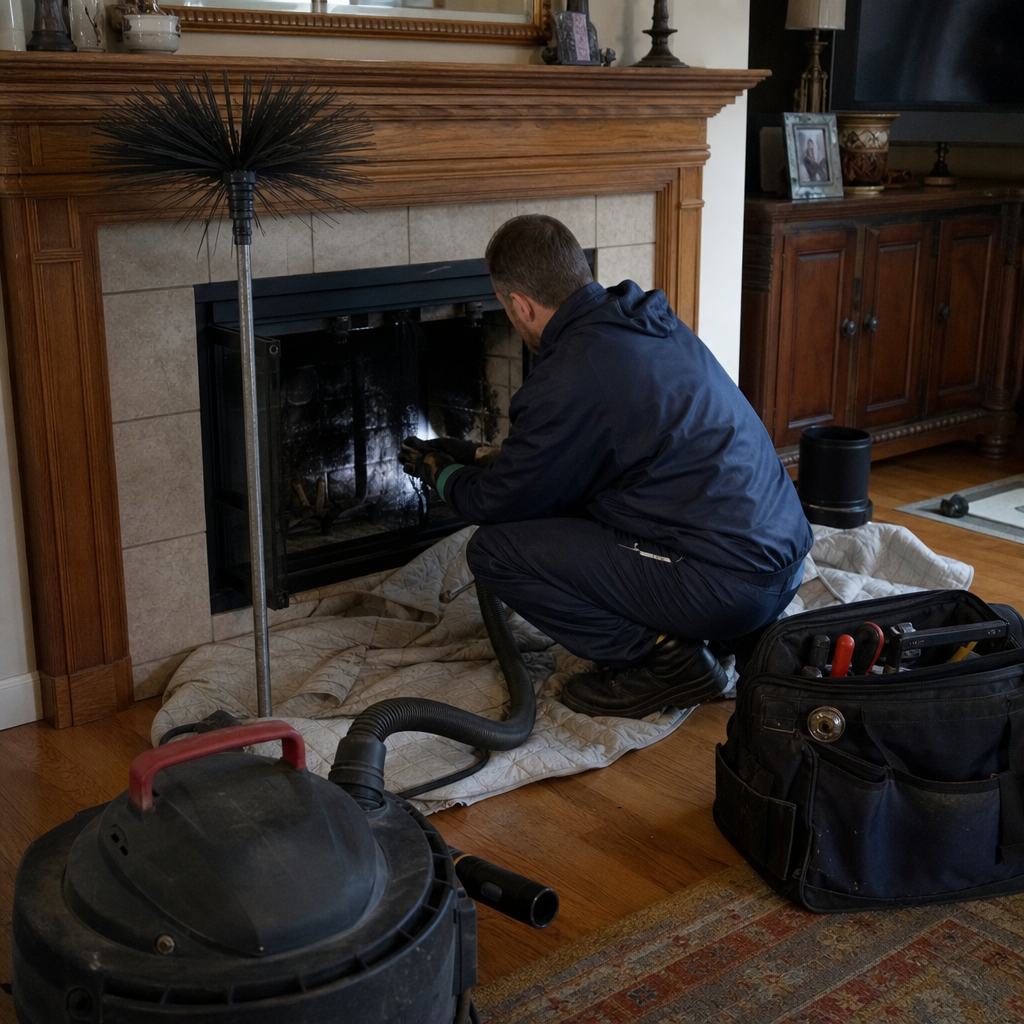
Every recommendation we make starts with a Level 2 inspection per NFPA 211 standards — visual examination plus video scanning of the entire flue interior. James Wilson performs these personally, and what the camera reveals often contradicts what a general contractor or HVAC technician told the homeowner.
We’ve lost count of how many times we’ve arrived at a Washington home where the previous contractor — usually someone who installs furnaces or water heaters, not someone who works inside chimneys — declared the liner “shot” based on a flashlight glance from the fireplace opening. The camera tells a different story. Hairline cracking without tile displacement? HeatShield candidate. One or two cracked tiles at the top, sound below? Spot repair and resurfacing. Complete tile collapse or flue oversizing for the appliance? That’s when we spec DuraFlex.
The diagnostic honesty matters because we carry both systems. A company that only installs stainless liners will always recommend stainless liners. A company that only does resurfacing will always recommend resurfacing. We’ve built Horizon Chimney Sweep to do both — plus poured-in-place when necessary — because the right fix is the one that matches the damage, not the one that matches our inventory.
James Wilson grew up in the Tenleytown neighborhood and learned this trade from a sweep who taught him what textbooks never cover: what a chimney actually looks like after fifteen winters of neglect. That apprenticeship, combined with 17 years of hands-on work in Washington homes, means we’re not guessing when we recommend a solution. We’ve seen this pattern before — in your neighborhood, in your housing type, with your specific appliance configuration.
When Your HVAC Contractor Says You Need a Liner — What to Verify
This scenario plays out regularly in Washington: a homeowner installs a new furnace, boiler, or water heater, and the installing contractor — who may never have been on a roof in his career — hands them a quote for “chimney liner installation” as a required add-on. Sometimes it’s required. Often, it’s not the full picture.
Here’s what we advise homeowners to check before proceeding:
- Did the contractor perform a video inspection of the existing flue, or are they assuming it needs replacement based on age?
- Is the proposed liner sized correctly for the appliance’s BTU output and venting category — or are they using a one-size-fits-all approach?
- Does the quote include a new cap, connector pipe, and proper termination — or will you be calling someone else to finish the job?
- Is the contractor proposing to vent multiple appliances into a single liner, which requires specific clearance and sizing calculations?
We’ve corrected installations in Brookland and Petworth where an HVAC contractor ran a single flexible liner for both a furnace and a water heater without proper sizing — creating a backdraft hazard that the homeowner discovered when their carbon monoxide detector alarmed. The original installer was long gone. We fixed it properly with a correctly sized DuraFlex system and separate venting where required.
The point isn’t to distrust every HVAC contractor. It’s to recognize that chimney venting is a specialty, and the person who sizes your ductwork isn’t necessarily qualified to evaluate your flue. A quick call to (866) 541-8697 gets you a second opinion from someone who evaluates chimneys exclusively — and has done so for over 1,006 verified customer reviews worth of Washington homeowners.
Breaking the Cost Down: What You’re Actually Paying For
Sticker shock is common with liner work, so we frame it in terms that make sense. A properly installed DuraFlex liner, maintained with annual sweeps, delivers 20–30 years of service. At $3,500 average installed cost, that’s roughly $117–$175 per year — less than most homeowners spend on streaming services — to ensure safe venting of combustion gases through a system designed for your specific appliance.
The annual sweep requirement isn’t upselling. Stainless liners still accumulate creosote (with wood) or acidic condensation residue (with gas), and the warranty requires documented maintenance. We offer Washington homeowners a sweep-and-inspect program that keeps the warranty valid and catches problems before they become expensive.
HeatShield resurfacing at $1,800 average cost, with 15–20 year life, runs even less per year — but only when it’s the correct application. We’ve had homeowners request HeatShield to save money when their tiles were already displaced, which would be like painting over rotted wood. We won’t do it. The inspection determines the solution, not the budget.
Common Local Scenarios We See in Washington Homes
The Capitol Hill Rowhouse with Original Clay
Built 1890–1920, narrow flue, maybe 6×6 inches interior. Homeowner installs a gas insert to replace a wood-burning fireplace. The 4-inch-equivalent clay liner is now oversized for the reduced gas flow, causing condensation that drips back into the firebox and stains the hearth. We typically spec a downsized DuraFlex liner with proper insulation — solving the condensation problem without rebuilding the chimney.
The Chevy Chase Colonial with Spalled Top Tiles
Water infiltration through a deteriorated crown (common in Washington’s wet winters) has damaged the top 3–4 feet of clay liner. Below that, the tiles are sound but stained. Rather than full replacement, we remove the damaged top section, repair the crown with proper Gelco or Olympia Chimney materials, and apply HeatShield to the remaining flue. Cost lands in the $1,800–$2,600 range instead of $4,000+.
The Adams Morgan Condo Conversion
Older building, multiple units sharing a common chimney, irregular flue shape from decades of modifications. No flexible liner will navigate the offsets cleanly. We spec poured-in-place to create a new, smooth, correctly sized flue within the existing structure — often working with building management to coordinate access and minimize disruption.
The Woodley Park Home with “Just a Crack”
Homeowner noticed a draft issue, had a handyman look, was told “the liner’s cracked, you need a new one.” Our camera inspection reveals a single hairline crack, no tile displacement, no evidence of leakage into surrounding masonry. HeatShield application, $1,400, problem solved. The handyman wasn’t wrong that something was wrong — but his solution was wrong for the actual condition.
What Affects Your Specific Price in Washington
Several variables move the needle within those ranges:
- Flue height and accessibility: Three-story rowhouses in Georgetown require more liner material and more labor time than single-story bungalows in Takoma.
- Appliance configuration: Connecting to a furnace in the basement adds vertical run and potentially horizontal connector work.
- Crown and cap condition: If the crown is cracked — and in Washington, it usually is — water will destroy the new liner without proper protection. We typically recommend Gelco or Famco caps with proper spark arrestors.
- Smoke chamber condition: The area above the fireplace damper often needs parging (smoothing) to reduce turbulence and improve draft, especially in pre-1940s construction.
- Permit requirements: Washington, DC requires permits for chimney modifications in many cases; we handle the paperwork, but it adds time and modest cost.
We don’t quote over the phone for liner work. The inspection takes 45–60 minutes, the video is yours to keep, and you’ll know exactly what we found before we discuss solutions. No pressure, no same-day closing tactics — just the information you need to make a decision.
FAQs
Full stainless steel liner installation typically costs $2,500–$5,000 in Washington, while HeatShield ceramic resurfacing of an existing liner runs $1,200–$2,400. Poured-in-place liners for severe damage range from $4,000–$7,500. The only way to know which applies to your chimney is a Level 2 video inspection. Call (866) 541-8697 to schedule — estimates are free.
HeatShield resurfacing is cheaper than full replacement when the clay tiles are intact with only hairline cracks, but it’s not suitable for displaced, spalled, or collapsed tiles. We’ve saved Washington homeowners thousands by correctly identifying resurfacing candidates — and we’ve refused to resurface liners where replacement was the safe choice. The inspection determines the answer, not the budget.
We don’t — and you shouldn’t want us to. Proper liner installation requires precise measurement, correct material ordering, and typically 2–4 hours of protected work time. Same-day installation means pre-loaded truck stock and rushed measurement, which is how liners end up incorrectly sized. We inspect, report, schedule, and return with the right materials for your specific flue.
A DuraFlex stainless flexible liner lasts 20–30 years with annual maintenance; HeatShield resurfacing lasts 15–20 years; poured-in-place liners exceed 25 years. The key variable isn’t the material — it’s whether the installation was done correctly and whether you keep up with annual sweeps. We warranty our workmanship and help you maintain manufacturer warranty compliance through our sweep program.
Ready to Know What Your Chimney Actually Needs?
Stop guessing based on a flashlight inspection or a contractor’s opinion from three rooms away. James Wilson will put a camera in your flue, show you what we found, and explain whether HeatShield, DuraFlex, or poured-in-place is the right solution for your Washington home — with upfront pricing and no obligation to proceed. Call (866) 541-8697 or visit our home page to schedule your free estimate. A clean chimney isn’t a luxury — it’s just the part of your house that’s been quietly doing its job and deserves the same attention as everything else.
For more details on our full liner and rebuild services, see our Chimney Liner & Rebuild page.
Written by James Wilson, Owner & Lead Technician at Horizon Chimney Sweep Washington, serving Washington, WA.